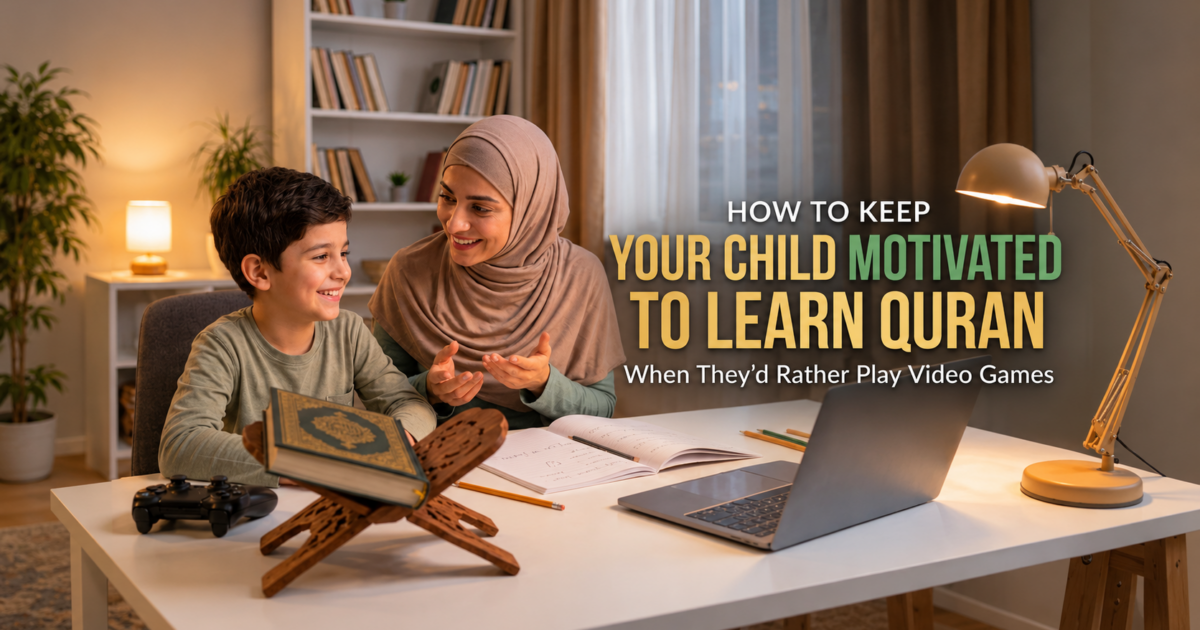
Every Muslim parent in today’s digital era knows the familiar evening standoff. It is 5:30 PM, your ten-year-old is locked into an intense round of Roblox, Fortnite, or Minecraft, wearing gaming headphones and rapidly clicking away. You gently announce that it is time for Quran class. What follows is an all-too-common response: deep sighs, dragging feet, complaints of fatigue, or outright bargaining for “just five more minutes.”
As parents, this cycle triggers deep internal anxiety. We worry about our children’s spiritual connection, their moral foundation in an increasingly secular society, and whether they will grow up loving the Book of Allah. In frustration, many households resort to strict ultimatums, taking away devices abruptly, or using punitive tones.
Yet, shaming or forcing a child rarely creates genuine love for sacred learning. In fact, heavy-handed approaches can cause a child to subconsciously associate the Quran with punishment and friction, while viewing video games as their only emotional escape.
To win this battle, we have to stop treating video games as an enemy that must be crushed and start understanding the underlying child psychology. Video games succeed because they master human motivation: immediate feedback, clear milestones, low shame for mistakes, and constant dopamine rewards.
By taking those very same engagement principles and infusing them into a nurturing, home-based Islamic routine, you can inspire your child to close their consoles willingly and sit down for their lessons with real enthusiasm.
For parents looking to replace traditional, rigid lectures with engaging, child-centered digital classrooms, exploring interactive 1-on-1 programs via The Quranic Academy provides an ideal bridge, blending interactive whiteboards and qualified mentorship right from the home computer.
The Brain Chemistry: Why Video Games Win the Battle for Attention
Before expecting a child to switch from high-intensity gaming to reading classical Arabic text, parents must understand what is happening inside the child’s brain.
Video Game Environment:
High Dopamine Surge ➔ Instant Visual/Audio Rewards ➔ Clear Next Level ➔ Zero Fear of Failure (Instant Retry)
Traditional Strict Quran Lesson:
Low Stimulus ➔ Abstract Future Rewards ➔ Fear of Being Scolded for Slips ➔ Mental Fatigue
The Dopamine Trap
Video games are meticulously engineered by behavioral psychologists to deliver continuous micro-rewards. Completing a quest, leveling up, unlocking a new skin, or hearing an upbeat sound effect releases dopamine—the neurotransmitter responsible for motivation and pleasure.
In contrast, sitting down to decode complex Arabic phonetics, memorizing difficult throat letters (Makharij), or repeating a verse ten times feels mentally demanding and quiet. When you ask a child to transition instantly from peak dopamine to quiet focus, their brain experiences what feels like an abrupt chemical crash.
The Problem with Guilt-Based Parenting
Telling an eight-year-old, “You spend hours on PlayStation, but you can’t even give Allah fifteen minutes!” might make you feel vindicated, but it builds resentment in the child. Children do not process adult abstract concepts of duty and guilt effectively. What they hear is: “The things I love are bad, and reading Quran makes my parents angry with me.”
To foster a lifelong, heartfelt connection with the Quran, our pedagogical approach must evolve from guilt to encouragement, structure, and positive reinforcement.
Practical Strategies to Shift Motivation Without Constant Fights
Transforming your child’s attitude toward Quran learning requires systematic environmental shifts rather than daily emotional battles. Here are five practical, field-tested strategies:
1. Build a “Dopamine Buffer Zone” (Never Transition Instantly)
The biggest mistake parents make is calling a child to Quran class directly while their game is still in session. Forcing a child to shut off a live multiplayer match creates instant anger.
Instead, introduce a 15-minute buffer zone:
- Set a visual timer on the kitchen counter or digital assistant 15 minutes prior to class.
- When the timer sounds, have your child save their progress, close the screen, and step away from the desk.
- Use those 15 minutes for physical movement: drink a glass of water, do a quick stretch, perform Wudu, and sit in a different chair.
- This transition period allows the brain’s dopamine levels to recalibrate before spiritual focus begins.
2. Gamify the Quran Journey: Levels, Badges, and Visible Progress
Children love games because they always know their exact score and how close they are to the next achievement. Bring that visual clarity into your home Quran routine.
| Traditional Method | Gamified Home System | Why It Motivates Children |
| Telling the child: “Keep reciting until I say stop.” | Setting a clear challenge: “Today’s mission is unlocking verses 1 to 5.” | Provides a clear finish line, preventing mental fatigue. |
| Verbal criticism for pronunciation slips. | Tracking “Streak Days” on a colorful wall chart. | Motivates the child to protect their ongoing habit streak. |
| Abstract long-term goals (e.g., “You’ll be glad when you’re older”). | Real-world milestone rewards (e.g., favorite outing after finishing Juz 30). | Translates hard work into tangible, immediate celebration. |
Create a physical progress tracker on the refrigerator or study room wall. Break chapters down into visual levels. For example, mastering the articulation of heavy letters (Huroof Musta’liyah) becomes “Unlocking the Strong Sounds Quest.” Every time your child completes a page without a stumble, let them place a gold star on their tracker.
3. Separate the Gaming Space from the Sacred Learning Nook
Spatial association is powerful. If a child sits in the exact same chair where they game, with their gaming controller within reach and Discord notifications pinging in the background, their brain remains wired for gaming.
Establish a dedicated, clean, and distinct study nook used exclusively for sacred learning. Keep this desk clear of gaming peripherals, toys, and clutter. Place a physical, beautifully bounded Mushaf on a wooden stand (Rehal). When a child enters this physical space, their brain naturally shifts into a calmer, more respectful frame of mind.
The Power of Explaining the “Why”: Connecting Heart to Ayah
One reason children find gaming more engaging than Quran reading is that video games present clear narratives: there is a hero, an obstacle, and a triumph. When Quran instruction is reduced strictly to mechanical phonetics without any meaning, children see it as nothing more than strange, difficult foreign words.
You can instantly reignite your child’s curiosity by introducing the dramatic narratives woven throughout the Quran:
- Surah Al-Kahf: Talk about the young men of the cave escaping a tyrannical king and waking up three centuries later, or the incredible journeys of Dhul-Qarnayn building a massive iron wall.
- Surah Al-Fil: Describe the massive army of elephants marching toward the Kaaba, only to be stopped by flocks of small birds casting clay stones.
- Surah An-Naml: Share the story of Prophet Sulaiman (AS) listening to the tiny ant warning its community to take cover.
When you spend just three minutes before each lesson explaining the context of the Surah, your child stops viewing recitation as a mechanical chore. They realize they are reciting the living speech of the Creator, rich with adventure, guidance, and truth.
When Passion Takes Root: Transitioning into Systematic Memorization
As your home routine stabilizes and your child begins reading with accurate Tajweed and genuine focus, you will often notice their appetite for learning expand. What initially started as an uphill battle against video games can evolve into an authentic pride in their recitation skills.
When a child discovers that their memory is sharp, you have an incredible window of opportunity to guide them toward structured memorization (Hifz). Memorization channels that natural competitive energy—the exact same drive they use to master levels in gaming—toward conquering sacred Surahs.
Rather than managing this heavy task alone at the dinner table, enrolling your child in a structured Quran memorization course for kids provides professional accountability. Under certified Hifz instructors, children benefit from a systematic schedule using the classical three-tier approach:
- Sabaq: The fresh daily assignment (memorized with 100% correct Tajweed).
- Sabqi: Daily revision of recent verses to anchor them into working memory.
- Manzil: Rotating cycles of older, mastered portions to protect them for life.
With a professional instructor celebrating every completed page, tracking retention metrics, and awarding regular digital milestones, children experience the thrill of progress—satisfying their intrinsic desire for achievement in an enduring, spiritual way.
Finding the Right Instructor: The Teacher Makes or Breaks the Subject
A child’s love for any subject is directly tied to the warmth and skill of their teacher. In the past, many of us experienced teachers who relied on fear, impatience, or harsh tones. For a child growing up with modern screens and supportive school environments, an authoritarian teaching style will instantly kill their desire to learn.
When selecting an instructor for your child, look for three vital pedagogical qualities:
Qualities of an Effective Modern Quran Tutor:
├── Unshakable Patience: Treats mistakes as learning steps, not failures
├── Bilingual & Relatable: Speaks fluent English and understands modern school contexts
└── Positive Reinforcer: Uses verbal praise (“SubhanAllah! What a beautiful recitation!”)
An instructor who smiles, asks about your child’s day, validates their hard work, and uses digital tools (like virtual highlighters and interactive exercises) creates an environment where the child feels safe to try, stumble, and improve. When children genuinely respect and like their tutor, they show up to class on time out of personal pride rather than parental coercion.
A Sustainable Daily Routine for Working Families
Consistency always beats intensity. Expecting an elementary or middle school child to study Quran for an hour every evening after a full school day is unrealistic. It drains their energy reserves and invites rebellion.
The most effective, battle-tested schedule is the 30/30 Rule:
- 30 Minutes of Focused Quran Learning (4 to 5 Days a Week): An uninterrupted, dedicated lesson where the child gives their complete energy.
- 30 Minutes of Earned Screen Time Afterwards: Position video games not as the baseline right that gets interrupted, but as the earned leisure reward that follows the completion of their daily duties (homework, prayer, and Quran).
When a child knows that a manageable 30-minute Quran session stands between them and their earned relaxation time, they focus with far greater urgency and finish their lesson with pride.
Cultivating a Heart That Loves the Divine Word
Raising righteous, Quran-conscious children in a high-tech world is an ongoing journey of patience, wisdom, and continuous dua. Video games will always offer bright colors, fast sounds, and instant thrills, but they can never offer what the Quran brings into a young person’s life: deep tranquility (Sakinah), moral clarity, and an eternal compass.
Do not lose hope when resistance flares up. Step back, adjust your routine, eliminate the guilt, and bring structure, warmth, and gamified celebration into your home. With steady habits, the right mentorship, and a parent’s loving encouragement, your child will not only put down their controller—they will build a lifelong, loving bond with the Book of Allah.