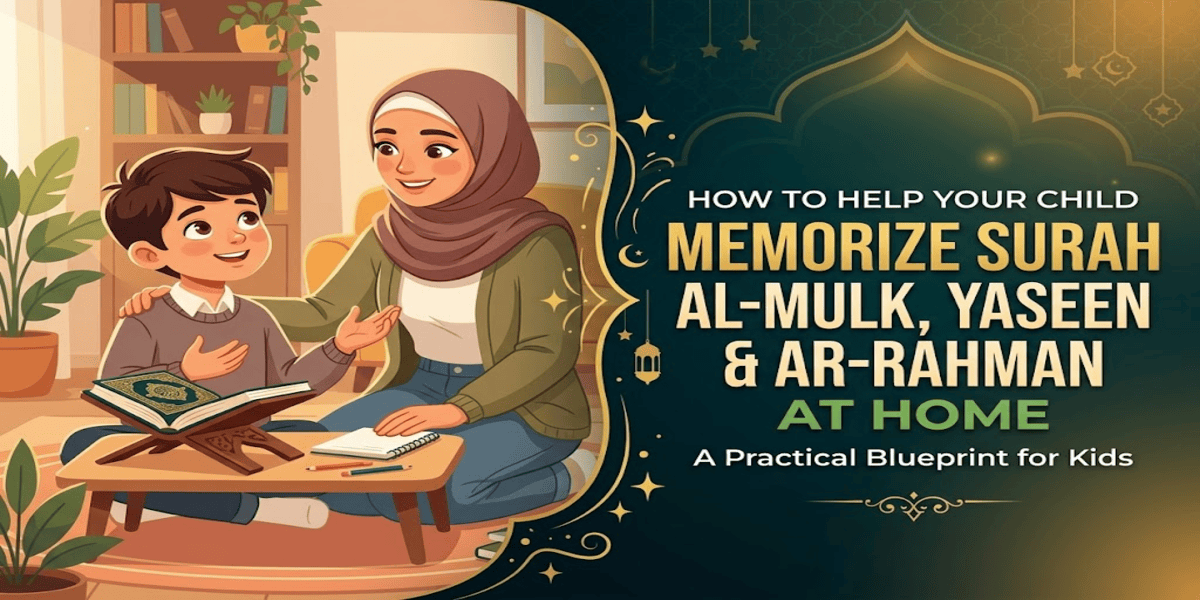
For many practicing Muslim families, guiding a child through the memorization of key chapters of the Holy Quran is a deeply cherished ambition. While memorizing the entire Quran (Hifz al-Quran) is a profound blessing, many households intentionally focus on anchoring monumental, virtue-filled Surahs into their children’s hearts first. Among these, three chapters hold a singular place in the daily rhythm of Muslim life: Surah Al-Mulk, Surah Yaseen, and Surah Ar-Rahman.
These Surahs are frequently recited in homes across the world. Surah Al-Mulk acts as an intercessor in the grave and a nightly protection; Surah Yaseen is described as the beating heart of the Quran; and Surah Ar-Rahman serves as a breathtaking, repetitive reflection on Allah’s infinite mercy, blessings, and creation.
Yet, when parents sit down with their eight- or ten-year-old to tackle chapters spanning dozens of verses, reality quickly sets in. Children can become intimidated by long passages, vowels get mixed up, and busy school schedules derail good intentions. Memorizing these magnificent chapters does not require pulling your child out of regular schooling or subjecting them to exhausting, high-pressure evening cramming. With the right pedagogical sequence, consistent audio exposure, and systematic retention routines, your child can commit these Surahs to memory right from home with confidence and genuine joy.
If your child is starting their reading journey or needs to polish basic pronunciation before committing longer chapters to memory, starting with certified, one-on-one guidance through The Quranic Academy provides the strong phonetic foundation that makes all future memorization significantly easier.
Laying the Groundwork: Prerequisites Before Memorizing Long Surahs
Before diving directly into Surah Al-Mulk or Surah Yaseen, parents must ensure that two foundational pillars are firmly established. Attempting to memorize long Surahs prematurely is the leading cause of frustration and vocal errors.
Accurate Reading and Tajweed (Nazra Fluency)
A child should never memorize a Surah purely by guessing or repeating blindly without being able to look at the text and decode the letters accurately. If a child’s grip on Noorani Qaida rules—such as the clear distinction between ت (Taa) and ط (Twaa), or the rules of Noon Sakinah and Ghunnah—is shaky, they will inevitably memorize errors. Correcting an ingrained mistake in a memorized verse takes three times longer than learning it properly from scratch. To help children build a strong foundation before memorization, parents can review these Tajweed rules with simple examples to understand correct Quranic pronunciation and recitation.
The Power of Passive Auditory Imprinting
Young children possess an extraordinary auditory memory. Before your child ever opens the Mushaf to begin memorizing Surah Ar-Rahman or Surah Al-Mulk, let that specific Surah become the background soundscape of your home for two to three weeks:
- Play a slow, clear recitation (such as Sheikh Mahmud Khalil Al-Husary or Sheikh Minshawi with student repetition) during the morning drive to school.
- Play Surah Al-Mulk softly in their bedroom as they wind down for bed.
- Play Surah Ar-Rahman while they complete quiet morning routines.
By the time the child sits down to intentionally memorize verse 1, the cadence, rhythm, and vocal transitions are already familiar to their subconscious ear.
A Strategic Sequence: Which Surah Should Come First?
While all three Surahs are beloved, tackling them in the wrong order can easily overwhelm a young learner. The most pedagogically sound sequence begins with structural simplicity and builds up to narrative complexity:
Step 1: Surah Al-Mulk (30 Verses)
├── Shorter, rhyming verses (Rhythm & Flow)
├── Practical daily application: Sunnah before sleeping
└── Achievable timeline: 4 to 6 weeks
Step 2: Surah Ar-Rahman (78 Verses)
├── Highly repetitive anchor verse: “Fabi-ayyi ala-i Rabbikuma tukaththiban” (Repeated 31 times)
├── Clear, vivid imagery of creation, Jannah, and Jahannam
└── Achievable timeline: 6 to 8 weeks
Step 3: Surah Yaseen (83 Verses)
├── Diverse vocabulary, prophetic narratives, and deeper theological phrasing
├── Longer thematic passages requiring sustained mental stamina
└── Achievable timeline: 8 to 12 weeks
The Verse-by-Verse Action Plan for Each Surah
Phase 1: Surah Al-Mulk (The Protector)
Surah Al-Mulk consists of 30 verses. Its rhythmic, rhyming endings (such as Qadeer, Nazeer, Kabeer, Baseer) make it naturally engaging for a child’s tongue.
- Target Pace: 1 verse per day (5 days a week), reserving weekends entirely for full cumulative review.
- The “Bedtime Routine” Anchor: Because the Prophet ﷺ encouraged reciting Surah Al-Mulk before sleeping, tie this Surah directly to your child’s nighttime habit. Every night, read the verses memorized so far right before lights out.
- Spotlight on Difficult Transitions: Verses 6 to 11 contain vivid descriptions of the fire and the dialogue of the keepers of hell. Break these into single sentences, ensuring the child grasps the vocal pauses (Waqf) correctly.
Phase 2: Surah Ar-Rahman (The Beauty of Divine Favors)
With 78 verses, Surah Ar-Rahman looks lengthy on paper, but it is practically the easiest long Surah for a young mind to absorb due to its repeating refrain:
فَبِأَيِّ آلَاءِ رَبِّكُمَا تُكَذِّبَانِ\text{فَبِأَيِّ آلَاءِ رَبِّكُمَا تُكَذِّبَانِ}فَبِأَيِّ آلَاءِ رَبِّكُمَا تُكَذِّبَانِ
(“So which of the favors of your Lord will you deny?”)
Because this single verse appears 31 times, your child is actually only memorizing 47 unique verses.
- The “Call and Response” Technique: In the beginning, have your child memorize the unique verses, while you recite the refrain alongside them. Alternate roles as they build confidence.
- Visualizing the Themes: Surah Ar-Rahman paints vivid pictures: the sun and the moon moving along calculated paths, palm trees with clusters of fruit, pearls and coral emerging from the sea, and lush green gardens of Paradise. Help your child visualize these scenes; when a child knows what the verse is describing, word retention jumps dramatically.
Phase 3: Surah Yaseen (The Heart of the Quran)
Surah Yaseen is 83 verses long and contains complex historical stories (the companions of the city, the warning of the messengers) and philosophical arguments about resurrection.
- Break It into Logical Thematic Quarters: Never present all 83 verses as a single massive mountain. Divide it into four digestible quarters:
- Verses 1 to 21: The truth of the Quran and the warning to the heedless.
- Verses 22 to 40: The story of the righteous man who supported the messengers, followed by signs in nature (the dead earth brought to life, the night and day).
- Verses 41 to 65: The human ships, the sudden blast of the trumpet, and the assembly on the Day of Judgment.
- Verses 66 to 83: Allah’s creative power, the reminder of the bones returning to life, and the climactic declaration of His sovereignty.
- Focus on Small Chunks: Assign only 2 to 3 lines per day. Never push to the next thematic quarter until the previous one can be recited from memory without a single hesitation.
The Classical Three-Tier Hifz System: Adapted for Home
To ensure that newly learned verses do not slip away, parents should adopt the classical framework utilized by master Quran academies worldwide: Sabaq, Sabqi, and Manzil.
| Category | Definition | Daily Time Allocation | What the Parent/Tutor Does |
| Sabaq (New Lesson) | The brand-new 1 to 2 verses assigned for that day | 15 minutes | Child first recites the new verse from the Mushaf to ensure zero reading errors, then repeats it 10 to 15 times until memorized. |
| Sabqi (Recent Memory) | All verses memorized over the last 15 to 20 days within the current Surah | 10 to 15 minutes | The child recites this entire section from memory every single day. This transfers recent verses into permanent long-term memory. |
| Manzil (Mastered Revision) | The completed Surahs or older portions already mastered | 10 minutes | A rotating review of previously completed Surahs to prevent backsliding. |
If you find that your child thrives under this structured routine and shows natural capacity, enthusiasm, and vocal melody, you can elevate their learning beyond home-guided study. Enrolling them in a specialized, structured Quran memorization course for kids provides daily accountability under certified Hifz mentors who track revision logs, fine-tune delicate Tajweed nuances, and preserve every memorized chapter permanently.
Daily Memory Techniques That Work Wonders with Children
Memorization should never feel like a dull, monotonous struggle. Incorporating engaging, multi-sensory techniques turns daily lessons into a stimulating challenge.
1. The “Rule of Five” Repetition Loop
When memorizing a single long verse, break it into natural semantic segments of 3 to 4 words:
- Recite Segment A looking at the page 5 times.
- Close eyes and recite Segment A from memory 5 times.
- Recite Segment B looking at the page 5 times.
- Recite Segment B from memory 5 times.
- Connect Segment A and Segment B together and recite from memory 5 times.
This progressive linking technique eliminates the awkward pauses where children forget how the next word begins.
2. Physical Mushaf Consistency
Always ensure your child uses the exact same copy of the Mushaf (such as the standard 15-line Madinah script) throughout their entire memorization journey. Visual memory plays a massive, often underestimated role in Hifz. Over time, your child will mentally picture whether a verse sits at the top, middle, or bottom of the page, where the page turns, and how the lines are formatted. Changing fonts, apps, or editions constantly scrambles this mental snapshot.
3. Lead the Family in Prayer (Salah Integration)
There is no test of memorization more authentic than standing before Allah in prayer. Once your child has memorized the first 10 verses of Surah Al-Mulk or Surah Ar-Rahman, invite them to lead the family in Maghrib or Isha prayer, or have them recite those verses during their own Sunnah prayers. Standing in Salah forces complete cognitive presence and removes the crutch of relying on parental prompts.
Overcoming Common Roadblocks: A Parent’s Troubleshooting Guide
Roadblock: “My child stumbles repeatedly on the exact same verse.”
Diagnosis: The child memorized an auditory slip or a misread vowel during Sabaq.
Fix: Stop reciting from memory. Open the Mushaf, highlight the stumbling word with a light pencil, and have the child recite the corrected phrase looking at the page 10 times consecutively before closing the book.
Roadblock: “My child knows the verses individually but gets stuck linking them.”
Diagnosis: The transition phrases between verses have not been trained together.
Fix: Have the child practice saying the final word of the previous verse directly attached to the first word of the following verse 7 times in a row.
Roadblock: “Midweek school fatigue is causing emotional resistance.”
Diagnosis: Cognitive overload from school assignments and after-school commitments.
Fix: Pause new Sabaq for 48 hours. Shift purely into light revision of what they already love reciting, or sit together and listen to an inspiring translation/explanation of the verses they have mastered.
The Power of Reflection: Connecting Heart to Text
A child who memorizes words they do not understand can eventually lose motivation. To make Surah Al-Mulk, Yaseen, and Ar-Rahman come alive, spend 5 minutes every weekend exploring the profound stories within these chapters:
- In Surah Al-Mulk: Look out the window at the sky and read verse 3: “Look again; can you see any flaw?” Talk about the precision with which Allah created the universe, the flight of birds held up by none but the Most Merciful, and how the earth was made smooth for us to walk upon.
- In Surah Ar-Rahman: When serving your family fresh fruit or visiting a park, point out the pomegranate, the date palms, and the flowing springs mentioned in the text. Let them connect the divine words on the page with the tangible world around them.
- In Surah Yaseen: Share the inspiring courage of Habib An-Najjar (the believer in the city), who ran from the farthest end of town to urge his people to follow the messengers, and upon entering Paradise, wished his people only knew how his Lord had forgiven him.
When these timeless narratives take root in your child’s imagination, the Quran ceases to be an academic assignment. It becomes a beloved guide, a source of comfort, and a lifelong companion.
A Noble Investment with Eternal Rewards
Helping your child memorize Surah Al-Mulk, Surah Yaseen, and Surah Ar-Rahman is one of the greatest spiritual investments you will make as a parent. The moments you spend sitting together on the prayer rug, guiding their tongue across delicate Arabic letters, and listening to their melodious voices fill the corners of your home will remain among the most cherished memories of their upbringing.
Take the journey one verse at a time. Maintain absolute patience, celebrate every small milestone with warmth, and rely on consistent, structured daily habits. Through gentle encouragement, reliable teaching tools, and persistent dua, you will see the words of Allah permanently illuminated in your child’s heart.