Learning to read t
Quick answer: what are the main Tajweed rules? The core Tajweed rules are the four rules of noon saakin and tanween (izhar, idgham, iqlab and ikhfa), the three rules of meem saakin, ghunna on noon and meem with shaddah, qalqalah on ق ط ب ج د, madd (lengthening by 2, 4, 5 or 6 counts), lam shamsiyyah and qamariyyah, heavy and light letters, and the stop signs (waqf). Download the free one page Tajweed rules chart PDF below.
This guide breaks down the most important tajweed rules with examples, in plain English, so a complete beginner can follow along. You will also find a simple approach for keeping a printable reference PDF on hand for daily revision.
By the end, you will understand the core rules well enough to start practising them in your own recitation, and you will know exactly where to go for hands-on guidance when you are ready.
Key Takeaways
- Tajweed means giving every Arabic letter its proper pronunciation and rights during recitation.
- Beginners should learn one rule at a time instead of trying to memorise everything together.
- Core rules include Noon Sakinah, Meem Sakinah, Qalqalah, Madd, Laam rules, and Ghunna.
- Understanding basic terms like Harakah, Sukoon, and Shaddah makes every other rule easier to grasp.
- A printable tajweed rules PDF is useful for quick daily revision, but it works best alongside guided practice with a teacher.
What Is Tajweed and Why It Matters
Tajweed comes from the Arabic word jawwada, meaning “to make better” or “to improve.” In the context of Quran recitation, it refers to the rules that govern how each letter should be pronounced.
Here is why this matters. Arabic has letters that sound almost identical to an untrained ear, but changing one sound can change the meaning of a word entirely. Tajweed exists to protect both the pronunciation and the meaning of the Quran, preserving the way it was recited by Prophet Muhammad ﷺ.
You do not need to master tajweed before you start reading the Quran. But learning the rules early builds habits that are far harder to fix later. Most students begin with Noorani Qaida, which introduces Arabic letters and basic pronunciation, then move into full tajweed rules once they are reading comfortably.
Basic Arabic Terms You Should Know First
A few symbols show up constantly in tajweed rules. Learning them first makes every rule below much easier to follow.
Harakah
A harakah is a short vowel mark placed above or below a letter. The three basic ones are Fathah (a short “a” sound), Kasrah (a short “i” sound), and Dammah (a short “u” sound).
Sukoon
A sukoon (ْ) means the letter has no vowel sound at all. Most tajweed rules, including Noon Sakinah and Meem Sakinah, are built around what happens when a letter carries a sukoon.
Shaddah
A shaddah (ّ) shows that a letter should be pronounced twice, or held with extra emphasis. It is the key trigger behind the Ghunna rule further down.
Noon Sakinah and Tanween Rules
A “noon sakinah” is a noon letter (ن) with no vowel on it. “Tanween” refers to the double vowel marks at the end of a word. Both follow the same four rules, depending on which letter comes right after them.
Izhar (Clear Pronunciation)
When the noon is followed by one of six throat letters (ء ه ع ح غ خ), you pronounce it clearly and fully, with no change.
Example: in “مِنْ هَادٍ,” the noon is pronounced clearly because it is followed by هَ.
Idgham (Merging)
When the noon is followed by one of six specific letters (ي ر م ل و ن), the noon sound merges into the next letter instead of being pronounced on its own.
Example: “مِنْ رَبِّهِمْ”. The noon blends smoothly into the ر sound.
Iqlab (Changing Into Meem)
When the noon is followed by the letter ب, it changes into a soft meem sound with a light nasal tone.
Example: “أَنْبِئْهُمْ”. You hear a gentle meem sound right before the ب.
Ikhfa (Hiding the Sound)
For the remaining fifteen letters, the noon is pronounced with a light nasal sound, held for about two counts, without fully closing the mouth.
Example: “مِنْ شَرِّ”. The noon is neither fully clear nor fully merged; it sits somewhere in between.
Meem Sakinah Rules
A meem sakinah is a meem (م) with no vowel, and it follows three rules depending on the letter that comes next.
- Idgham Shafawi. When followed by another meem, the two merge into one sound. Example: “لَهُمْ مَا.”
- Ikhfa Shafawi. When followed by ب, the meem is pronounced softly with a slight nasal tone. Example: “تَرْمِيهِمْ بِحِجَارَةٍ.”
- Izhar Shafawi. For every other letter, the meem is pronounced clearly with closed lips.
Qalqalah: The Bouncing Sound
Qalqalah applies to five letters: ق ط ب ج د, often remembered with the phrase “قطب جد.” When one of these letters appears without a vowel, especially at the end of a word, it gets a short, bouncing echo instead of a flat, silent stop.
Example: in “يَجْعَلْ,” the ج carries a light bounce because of its sukoon.
Do not exaggerate the bounce. A simple way to practice: say the letter, then add a tiny puff of air right after it, like a gentle knock rather than a hard stop.
Madd Rules (Lengthening)
Madd means stretching a vowel sound, and getting the count right is one of the most common struggles for beginners. Stretching too short or too long changes the rhythm of the whole verse.
- Madd Asli (Natural Madd). The basic lengthening, held for two counts. Example: “قَالَ,” where the “aa” sound stretches naturally.
- Madd Far’i (Secondary Madd). Held for four to six counts, triggered by specific combinations such as a hamza or a shaddah following the long vowel. Madd Munfasil is one common type, occurring when a madd letter ends one word and a hamza begins the next.
Laam Rules: Shamsiyyah and Qamariyyah
These rules apply to the laam (ل) in the word “al” (ال) at the start of a word.
- Laam Shamsiyyah. The laam is silent, and the next letter is doubled instead. Example: “الشَّمْس” (the sun). You do not hear the laam at all.
- Laam Qamariyyah. The laam is pronounced clearly. Example: “القَمَر” (the moon). The laam is fully audible.
A handy trick: if the letter after “al” is one of fourteen “sun letters,” the laam disappears. Otherwise, it is pronounced.
Ghunna: The Nasal Sound
Ghunna is a soft nasal sound that comes through the nose. It appears whenever a noon or meem carries a shaddah, and it is normally held for about two counts.
Example: “إِنَّ”. The doubled noon carries a clear nasal buzz.
A common beginner mistake is holding Ghunna too long. Aim for roughly two counts unless another rule extends it, and listen to a skilled reciter to train your ear, since this sound is hard to learn from text alone.
Makharij: Where the Letters Come From
One of the most overlooked parts of tajweed is Makharij, the articulation points of Arabic letters. Every letter comes from a specific place in the mouth or throat, and confusing two nearby points is one of the fastest ways to change a word’s meaning by accident.
A few examples: ق comes from the back of the tongue, ك sits slightly forward of it, ع comes from the middle of the throat, and ح comes from the upper throat. Letters like ص, س, and ث sound similar to a beginner’s ear but come from different points and carry different qualities.
Practising Makharij alongside the rules above helps you avoid the single biggest source of mispronunciation among new students.
Common Mistakes Beginners Make
- Reading too fast. Slow reading helps you notice every rule as it comes up. Accuracy matters more than speed at this stage.
- Overstretching Madd. Not every long vowel needs several counts. Follow the specific Madd rule rather than guessing.
- Mixing up similar letters, especially ص/س and ح/خ, which sound close but come from different articulation points.
- Skipping daily practice. Ten focused minutes a day builds the habit far better than one long session once a week.
How to Practise These Rules Daily
- Pick one rule per week instead of trying to learn everything at once.
- Find five to ten examples of that rule in short surahs you already know.
- Recite those examples slowly, out loud, focusing only on that one rule.
- Listen to a qualified reciter and compare their pronunciation to your own.
- Get feedback from a tutor who can catch mistakes your own ear might miss.
That last step matters more than most people expect. Tajweed involves subtle sounds that are truly hard to self-correct, since your ear gets used to your own mistakes over time. A tutor who listens live and corrects you in real time will save you months of practising something the wrong way.
Where to Get a Free Tajweed Rules PDF
Keeping a one-page printed reference nearby makes practice far easier, especially in the early weeks when the rules still feel unfamiliar. A good PDF should include simple explanations, real Quran examples for each rule, and a quick-glance summary you can check mid-practice, without needing to flip through a full textbook. Treat it as a support tool, not a replacement for guided instruction.
At HolyQuranLearning, our tutors walk students through each of these rules individually during live one-to-one classes, correcting pronunciation in real time rather than leaving you to guess whether you are getting it right. If you would like a tutor to go through these rules with you personally, you can book a free trial class and start with whichever rule feels hardest.
Final Thoughts
Tajweed can feel overwhelming when you see all the rules laid out together, but nobody learns it all in one sitting. Most students pick up one rule at a time, practice it in real recitation, and build from there.
Start with the Noon Sakinah rules, since they show up constantly in everyday recitation. Once those feel natural, move on to Qalqalah and Madd, then round it out with Makharij practice. Progress in tajweed is steady, not sudden, and every small correction adds up over time.
People Also Ask
How many tajweed rules are there?
Scholars group them differently, so you will see counts ranging from around nine to seventeen depending on the source. The core categories, however, stay the same: Noon Sakinah rules, Meem Sakinah rules, Qalqalah, Madd, Laam rules, and Ghunna.
What is the easiest way to learn tajweed?
Start with Arabic letter pronunciation and Makharij, then learn one tajweed rule at a time. Daily practice paired with feedback from a qualified teacher helps you improve far faster than studying alone.
Is there a free tajweed rules with examples PDF?
Yes. Many Quran learning platforms and Islamic education sites offer printable beginner guides. Look for one with real Quran examples and a simple layout, and use it alongside a teacher rather than as a substitute for one.
How long does it take to learn basic tajweed?
Most beginners understand the basic rules within a few weeks to a few months of consistent practice. Becoming comfortable applying them naturally while reciting usually takes longer and depends on how often you practice.
Do I need to know Arabic before learning tajweed?
No. Many non-Arabic speakers learn tajweed successfully. You only need to recognise the Arabic letters and practice their correct pronunciation consistently.
What is the difference between tajweed and Quran memorisation?
Tajweed teaches you how to pronounce the Quran correctly, while memorisation focuses on remembering the verses. Many students work on both together, since correct pronunciation makes memorisation more accurate and easier to retain.
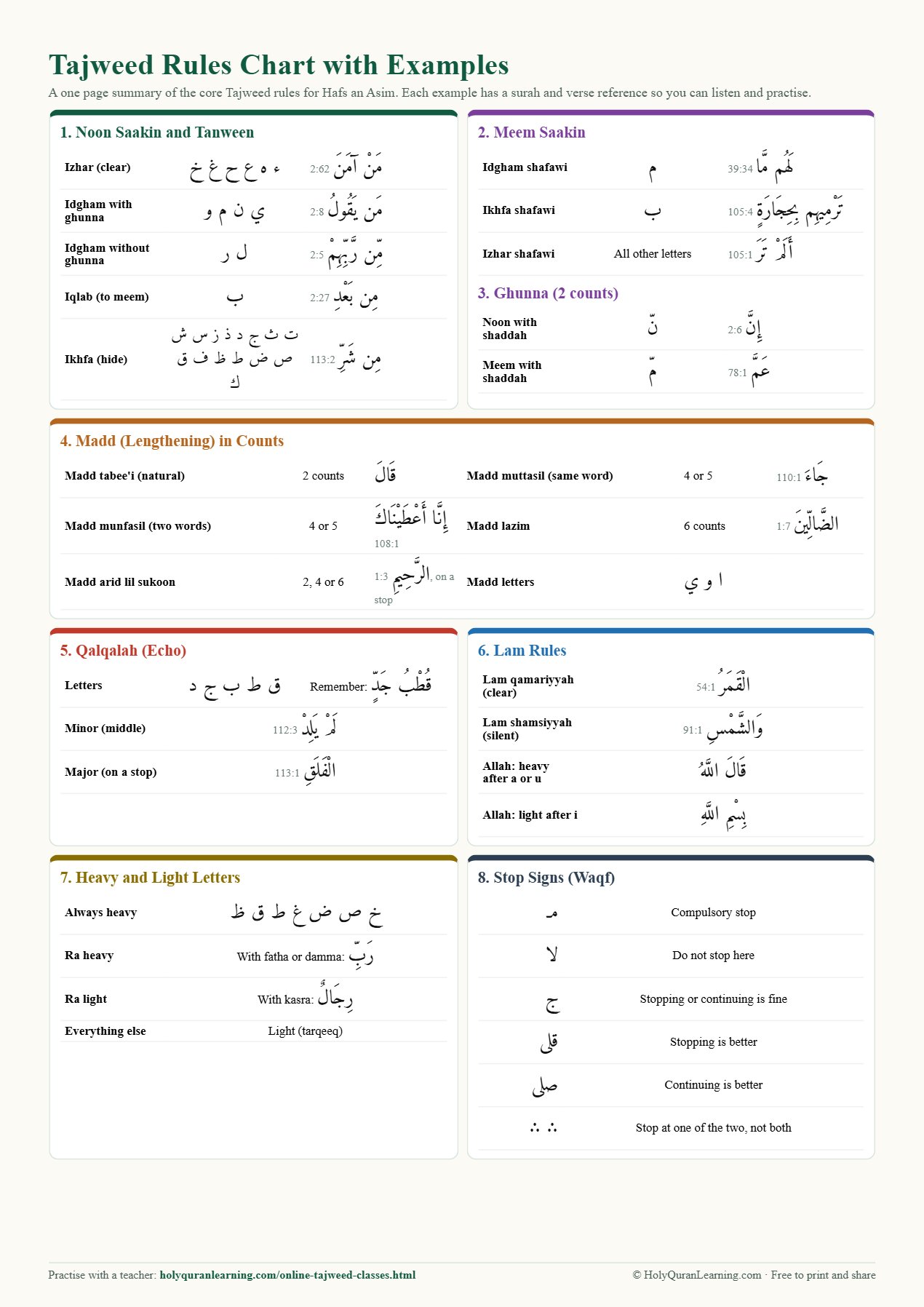
Tajweed Rules Chart With Examples (Free PDF)
Is there a free Tajweed rules with examples PDF?
Yes. This page has a free one page Tajweed rules chart PDF with a surah and verse reference for every example. Print it and keep it next to your Mushaf.
What are the heavy letters in Tajweed?
The seven heavy letters are خ ص ض غ ط ق ظ, grouped in خُصَّ ضَغْطٍ قِظْ. Ra and the lam in Allah are heavy in some cases and light in others.
How many counts is each madd?
Madd tabee’i is 2 counts, madd muttasil and munfasil are 4 or 5, madd lazim is 6, and madd arid lil sukoon is 2, 4 or 6 when you stop.
What do the waqf signs mean?
مـ means you must stop, لا means do not stop, ج means either is fine, قلى means stopping is better, and صلى means continuing is better.
Download the Tajweed Rules PDF (1 page, free)
The chart covers every rule in this guide with a surah and verse reference. Print it, keep it next to your Mushaf, and practise one rule each week.
You can download our free Tajweed rules chart PDF right now. It fits on one A4 page and includes every example from this guide.
Madd Counts at a Glance
| Type of madd | Counts | Example |
|---|---|---|
| Madd tabee’i (natural) | 2 | قَالَ |
| Madd muttasil (hamza in the same word) | 4 or 5 | جَاءَ (110:1) |
| Madd munfasil (hamza in the next word) | 4 or 5 | إِنَّا أَعْطَيْنَاكَ (108:1) |
| Madd lazim (sukoon or shaddah after the madd) | 6 | الضَّالِّينَ (1:7) |
| Madd arid lil sukoon (on a stop) | 2, 4 or 6 | الرَّحِيمِ (1:3) |
Heavy and Light Letters (Tafkheem and Tarqeeq)
Seven letters are always heavy. They are خ ص ض غ ط ق ظ, grouped in the phrase خُصَّ ضَغْطٍ قِظْ. You raise the back of the tongue so the sound is full. All other letters are light, with two exceptions:
- Ra: heavy with fatha or damma, as in رَبِّ, and light with kasra, as in رِجَالٌ.
- Lam in the name Allah: heavy after fatha or damma, as in قَالَ اللَّهُ, and light after kasra, as in بِسْمِ اللَّهِ.
Rules of Ra in Tajweed
The rules of Ra decide whether you read the letter Ra heavy (tafkheem) or light (tarqeeq). Look at the vowel on the Ra first. If the Ra has a sukoon, look at the vowel on the letter before it. These four cases cover most of the Quran:
| Case | Heavy or light | Example |
|---|---|---|
| Ra with fatha or damma | Heavy | رَبِّ |
| Ra with kasra | Light | رِجَالٌ |
| Ra with sukoon after fatha or damma | Heavy | مَرْيَمَ |
| Ra with sukoon after kasra | Light | فِرْعَوْنَ |
There are two common exceptions. Ra with sukoon after kasra is read heavy when a heavy letter follows it in the same word, as in قِرْطَاسٍ. It is also heavy when the kasra belongs to a joining hamza, as in ارْجِعُوا. When you stop on a Ra, treat it as sukoon and check the letter before it. Our online Tajweed classes practise each case with a teacher.
Waqf Signs: Where to Stop and Start
| Sign | Meaning |
|---|---|
| مـ | Compulsory stop. Stopping is necessary to keep the meaning. |
| لا | Do not stop here. |
| ج | Stopping or continuing are both fine. |
| قلى | Stopping is better. |
| صلى | Continuing is better. |
| ∴ ∴ | Stop at one of the two places, not both. |
When you stop on a word, the last vowel becomes a sukoon. If the word ends in a tanween with fatha, read it as a long alif, as in عَلِيمًا read as عَلِيمَا.
Isti’adhah and Basmalah: How to Begin Your Recitation
Begin with the isti’adhah, أَعُوذُ بِاللَّهِ مِنَ الشَّيْطَانِ الرَّجِيمِ, and then the basmalah, بِسْمِ اللَّهِ الرَّحْمَٰنِ الرَّحِيمِ. Surah At Tawbah is the only surah that does not start with the basmalah.
Tajweed Ke Qawaid in Urdu
تجوید کا مطلب ہے قرآن کو صحیح مخارج اور صفات کے ساتھ پڑھنا۔ بنیادی قواعد یہ ہیں: نون ساکن اور تنوین کے چار قاعدے (اظہار، ادغام، اقلاب، اخفاء)، میم ساکن کے تین قاعدے، غنہ، قلقلہ، مد، لام شمسی اور قمری، پُر اور باریک حروف، اور وقف کی علامات۔ ہر قاعدہ کسی استاد کے ساتھ مشق کرنے سے جلدی پختہ ہوتا ہے۔
Learn Each Rule in Depth
- Ikhfa: the 15 ikhfa letters with examples
- Idgham rules in Tajweed
- Ghunna rules in Tajweed
- Noorani Qaida guide for complete beginners
- Surah Mulk with Tajweed notes to practise every rule in one surah
- Online Tajweed classes with a qualified teacher