Choosing online Quran classes for your child in the UK comes down to five things: the right starting age, a clear learning path, a qualified tutor you trust, lessons that fit around the school day, and safety you can check for yourself. This guide walks through each one, with honest prices and the questions to ask before you sign up anywhere.
We teach children one-to-one, live, with a Hafiz or Hafiza tutor of your choice. Where it helps, we explain how our own classes work, but the checklists apply to any academy you are comparing.
Key Takeaways
- Most children are ready to start the Noorani Qaida at around 4 to 5 years old, with 20 to 30 minute lessons.
- The usual path is Noorani Qaida, then Quran reading (Nazra) with Tajweed, then memorisation (Hifz) for children who are ready.
- One-to-one online classes with us start at $35 a month for 8 lessons, with a free trial and no card needed.
- Weekday slots after school and weekend mornings fit most UK school routines.
- Before choosing any tutor, follow the NSPCC’s advice: ask about background checks, agree how the tutor contacts you, and stay within earshot.
How Do Online Quran Classes for Kids Work?
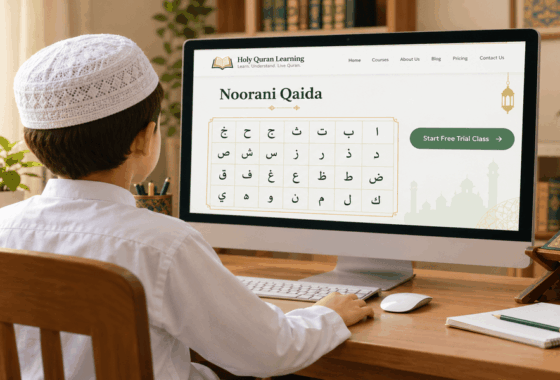
An online Quran class is a live video lesson between your child and a tutor, usually on a laptop or tablet. The tutor shares the lesson page on screen, listens to your child read, corrects pronunciation and sets a little practice for next time.
With us, a typical start looks like this:
- Free trial class. Your child meets the tutor, and the tutor checks their current level. You can sit in for the whole lesson.
- Level and plan. We suggest where to start (Qaida, reading, Tajweed or Hifz) and how many lessons a week suit your child’s age.
- Fixed weekly slots. You pick times around school, madrasah and activities, with a male or female tutor.
- Short, focused lessons. Each class is one-to-one for the full session, usually 30 minutes for younger children.
- Progress you can see. You get regular progress updates, and class recordings are available on every plan.
What Age Should a Child Start Learning the Quran?
Most children can start between 4 and 5 years old, once they can sit for a short lesson and recognise shapes and sounds. There is no upper limit: many children start at 8, 10 or later and catch up quickly with one-to-one teaching.
| Age | What they usually focus on | Lesson length | Lessons a week |
|---|---|---|---|
| 4 to 5 | Arabic letters and sounds (Noorani Qaida, first lessons) | 20 to 30 minutes | 2 |
| 6 to 8 | Joining letters, vowel marks, first Quran reading | 30 minutes | 2 to 3 |
| 9 to 12 | Fluent reading with Tajweed, short surahs, starting Hifz if ready | 30 to 45 minutes | 3 |
| 13 and over | Tajweed accuracy, Hifz or translation and meaning | 45 minutes | 3 or more |
These are starting points, not rules. A shy five-year-old may need a gentler pace, while a confident eight-year-old may move through the Qaida in a few months.
What Will My Child Learn? The Step-by-Step Path
Children learn best when each stage builds on the last. This is the order we follow, and it is the same order most madrasahs follow.
1. Noorani Qaida
The Qaida teaches the Arabic alphabet, joined letters, vowel marks (harakat), tanween, sukoon and shaddah. It is the foundation for everything that follows. You can read all 31 pages of the Noorani Qaida online, and our guide to learning Noorani Qaida explains each lesson in plain English.
2. Quran Reading (Nazra) with Tajweed
Once your child can read the Qaida smoothly, they move into the Quran itself, starting with short surahs. The tutor corrects pronunciation as they go, so good habits form early.
3. Tajweed Rules
Older children learn the rules behind correct recitation, such as noon sakinah, ghunnah and madd. Our article on Tajweed rules with simple examples is a useful companion for parents.
4. Hifz (Memorisation)
Hifz suits children who read fluently and enjoy recitation. Most start with Juz Amma (the 30th part). See our tips on how to memorise the Quran to support revision at home.
How long does each stage take? It depends on age, number of lessons and practice at home. As a rough guide, many children who take 2 to 3 lessons a week finish the Qaida within a few months to a year, then move on to reading.
How Much Do Online Quran Classes Cost in the UK?
Prices vary with lesson length, number of lessons a week and whether classes are one-to-one or group. Here is exactly what our one-to-one plans cost, so you can compare like for like:
| Plan | Lessons | Best for | Price |
|---|---|---|---|
| Starter | 8 a month (2 a week), 30 minutes | Noorani Qaida and Quran reading with Tajweed | $35 a month |
| Standard | 12 a month (3 a week), 45 minutes | Hifz, translation and tafseer | $50 a month |
| Elite | 6 a week | Serious students wanting all subjects and a senior tutor | $75 a month |
That works out at about $4.40 per one-to-one lesson on the Starter plan. Plans are billed in US dollars, so your bank converts the amount to pounds. Every plan starts with a free trial class (no card needed), and there is a 7-day satisfaction guarantee once you join. Full details are on our pricing page.
When comparing academies, check whether a quoted price is per lesson or per month, how long each lesson is, and whether it is one-to-one or a group class.
Are There Free Online Quran Classes for Kids?
Some mosques and community groups run free or donation-based classes, usually in groups. They can be a good option if your child is happy learning with others. Free one-to-one teaching is rare, but you can try a paid academy at no cost through a free trial. Our free Noorani Qaida PDF is also free to use at home.
Online Quran Classes vs Your Local Madrasah
Both have real benefits. Many families use a local madrasah for community and an online tutor for one-to-one reading practice.
| What matters | Online one-to-one class | Local madrasah or mosque class |
|---|---|---|
| Attention | Your child has the tutor’s full attention | Shared with a group |
| Travel | None, lessons happen at home | Drop-off and pick-up needed |
| Tutor choice | Choose a male or female tutor | Usually set by the madrasah |
| Pace | Moves at your child’s speed | Moves at the group’s speed |
| Parent visibility | You can watch any lesson | Limited |
| Community | Less social contact | Learning with friends and the wider community |
Fitting Quran Classes Around the UK School Day
UK families usually look for lessons after school, after homework, or at the weekend. Fixed slots work best because children settle into a routine. Here are three example timetables:
- Starter (2 a week): Monday and Wednesday at 5:00pm.
- Standard (3 a week): Tuesday and Thursday at 6:00pm, plus Saturday at 10:00am.
- Weekend focus: Saturday and Sunday mornings, ideal for busy weekdays.
Exact times depend on tutor availability, and we confirm them after the trial. When the UK clocks change in March and October, your lesson stays at the same UK time.
Keeping Your Child Safe in Online Lessons
The NSPCC’s advice on finding a tutor for your child applies to online Quran classes too. Before you commit to any academy, check these points:
- Background checks. Ask what checks and references the academy holds for its tutors.
- Contact goes through you. The tutor should contact the parent, never the child directly outside lessons.
- You can watch. You should be welcome to sit in on any lesson. With us, parents can join every class.
- Lessons in a shared space. Set up the laptop in a living room or kitchen, not a bedroom, and stay within earshot.
- Records and updates. Ask for progress updates and, ideally, class recordings, which are included in all our plans.
- Talk to your child. Check in regularly about how they feel in lessons.
The UK Safer Internet Centre also has simple guides on setting up devices safely for children.
How to Choose the Best Online Quran Class for Your Child
There is no single best academy for every child. The best class is the one your child enjoys and keeps attending. Use the free trial to check:
- Is the lesson one-to-one for the full time?
- Can you choose a male or female tutor?
- Did the tutor assess your child’s level before teaching?
- Is the pace right, not rushed and not too slow?
- Did your child understand the corrections?
- Are prices clear, with no long contract?
- Can you watch lessons and get progress updates?
- Did your child come away smiling and wanting to go back?
Tips to Keep Children Motivated
- Keep lessons short and regular rather than long and occasional.
- Practise for five minutes a day between lessons, ideally at the same time.
- Celebrate milestones, such as finishing the Qaida or the first surah memorised.
- Let your child recite to grandparents or at family gatherings.
- Stay positive about mistakes. Tajweed takes time for everyone.
Frequently Asked Questions
What age is best to start online Quran classes?
Most children can start the Noorani Qaida at around 4 to 5 years old with short 20 to 30 minute lessons. Older children and teenagers can start at any time and often progress quickly with one-to-one teaching.
How much do online Quran classes cost in the UK?
Prices depend on lesson length, frequency and whether lessons are one-to-one. Our one-to-one plans start at $35 a month for 8 lessons of 30 minutes, with a free trial class and no card needed.
Can my daughter have a female Quran teacher?
Yes. You can choose a male or female tutor (Hafiz or Hafiza) when you book the free trial.
How long is each online Quran class for kids?
Younger children usually have 30 minute lessons. Older children on our Standard plan have 45 minute lessons.
Can parents watch the lessons?
Yes. Parents can sit in on any lesson, and class recordings and regular progress updates are included.
What times are classes available for UK families?
Most families choose weekday slots after school or weekend mornings. We confirm exact times after the free trial based on tutor availability.
Are there free online Quran classes for kids?
Some mosques run free group classes. For one-to-one teaching, you can try our classes for free with a trial lesson, and our Noorani Qaida PDF is free to read online.
Start With a Free Trial Class
The easiest way to know if online Quran classes suit your child is to try one. Book a free trial class, sit in, and see how your child gets on. You can also explore our full range of Quran courses.
Looking for yourself too? Read our guide to online Quran classes for adults in the UK, or see local options for Birmingham and Bradford.