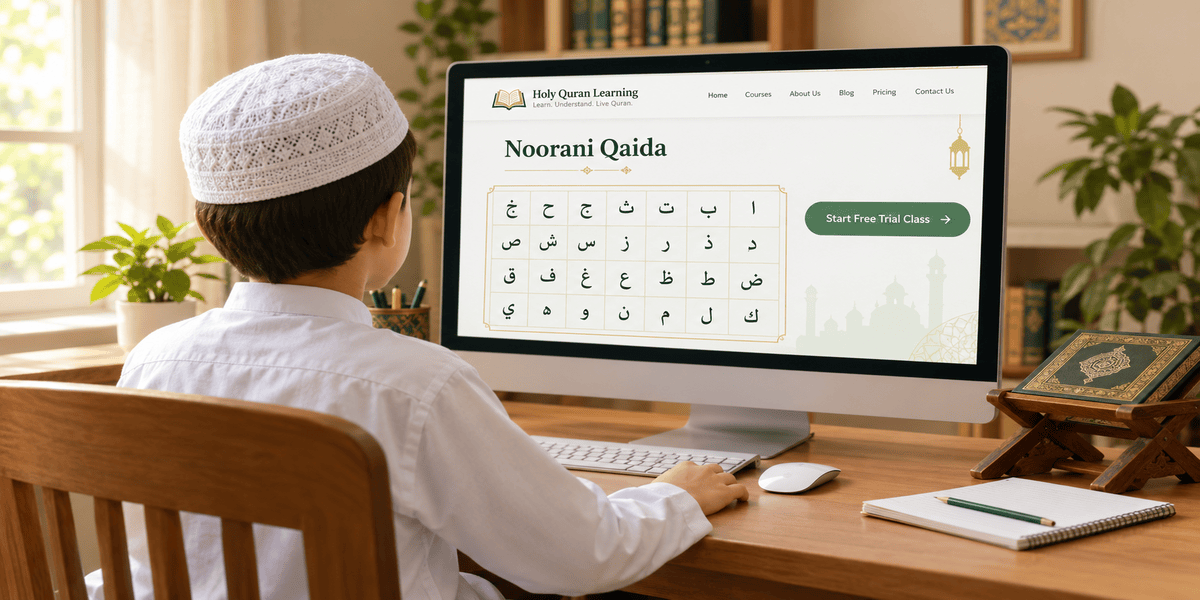
Noorani Qaida is a beginner primer that teaches Arabic letters, short vowels, and basic Tajweed so you can read the Quran correctly. Most learners finish it in about two to six months with daily practice and a teacher’s feedback. This guide walks you through every step, from your first letter to your first Quranic phrase.
Imagine a father in Toronto who wants to read the Quran with his daughter. He never learned Arabic as a child, so the pages look like a locked door. That is exactly where Noorani Qaida starts. It assumes you know nothing.
You will learn what the book covers, how the lessons work, and where the traditional takhti fits in. You will also get a simple daily plan and a free Noorani Qaida PDF so you can begin today. See all our free Islamic PDF downloads, including the complete Noorani Qaida in both Urdu and English.
Key Takeaways
- Noorani Qaida teaches letters, vowel marks, and core Tajweed to complete beginners.
- Most editions follow about 17 lessons, moving from single letters to short Quranic reading.
- Twenty to thirty minutes of daily practice beats one long weekend session.
- A PDF gives you the book, but a live teacher fixes the mistakes you cannot hear.
- Kids and adults can both learn online or in person.
- Noorani Qaida for beginners works best when you master each lesson before moving on.
What Is Noorani Qaida?
Noorani Qaida is a primer that teaches the Arabic alphabet, short vowels, and basic Tajweed rules to people who cannot yet read the Quran. The word Qaida means rule or foundation. Noorani comes from noor, the Arabic word for light.
The book starts with single letters and ends with short Quranic phrases. Each lesson builds on the one before it. Skipping ahead rarely works.
Who Should Learn It?
Anyone who cannot yet read Arabic script can start. The book suits:
- Children beginning their first Quran classes
- Adults who never learned Arabic as kids
- New Muslims who want a clear starting point
- Readers who can sound out words but make frequent errors
Age does not matter. A child of four and an adult of forty begin on the same page.
Why Start With the Qaida First?
Correct sounds protect the meaning of the words. One wrong letter sound can turn a word into a different word. A strong base saves you months of unlearning later.
Islam also honors this effort. According to Sahih Bukhari on Sunnah.com, the Prophet Muhammad (peace be upon him) said the best among you are those who learn the Quran and teach it. That is a good reason to start carefully.
Noorani Qaida Lessons: What You Will Learn
Noorani Qaida lessons follow a fixed order, and most editions share the same path. Numbering differs slightly between publishers, so treat this section as a map, not a strict rulebook.
Lesson 1: The Arabic Letters
Lesson 1 of Noorani Qaida teaches the 28 letters of the Arabic alphabet and how each one sounds. Britannica confirms that Arabic uses 28 letters. You also meet makhraj, the spot in your mouth or throat where each sound begins.
Watch the dots closely. Baa, Taa, and Thaa share one shape. Only the dots change the letter.
Lesson 2: Joined Letters
Arabic runs from right to left. Letters change shape when they sit at the start, middle, or end of a word. Lesson 2 shows how letters connect. This practice pays off in every later lesson.
Lessons 3 to 5: Harakat, Tanween, and Long Vowels
Harakat are the short vowel marks that sit above or below a letter. There are three:
- Fatha: a small line above the letter, sounds like “a”
- Kasra: a small line below the letter, sounds like “i”
- Damma: a small curl above the letter, sounds like “u”
Tanween doubles these marks and adds an “n” sound at the end. Long vowels stretch the sound. A Noorani Qaida with English transliteration helps a lot here, because a written pronunciation guide makes each mark easier to grasp.
Later Lessons: Sukoon, Shaddah, Qalqalah, and Madd
The final lessons add more Tajweed rules:
- Sukoon: a small circle that means the letter carries no vowel
- Shaddah: a mark that doubles a letter
- Qalqalah: a slight echo on five letters (Qaf, Taa, Baa, Jeem, Daal)
- Madd: the rule for stretching a sound
By the end, you read short Quranic phrases with steady flow.
Noorani Qaida Takhti: The Traditional Writing Board
The takhti is a small wooden board that students use to practice writing Arabic letters. In many South Asian classrooms, children write on it with a reed pen and wipe it clean after each lesson.
Writing builds memory. When you trace a letter, your hand remembers its shape. Many learners today use a whiteboard or plain paper instead. The takhti helps, but it is optional.
Pair your writing with reading aloud. Say each letter as you write it.
Noorani Qaida PDF: How to Use It Well
A Noorani Qaida PDF gives you free access to the full book, but it cannot hear your pronunciation. You can download the free PDF here and follow this routine:
- Open the PDF on a tablet or print it.
- Read one page aloud, slowly.
- Record your voice and listen back.
- Review yesterday’s page before you start a new one.
- Ask a teacher to check your recitation each week.
Step five matters most. Self study helps, but a tutor stops small errors from turning into habits. Ready to try? You can book a free trial class and hear the difference.
Learn Noorani Qaida Online or In Person?
You can learn Noorani Qaida online, at a local mosque, or with a home tutor. Each option works if the teacher knows Tajweed and listens closely.
Benefits of Learning Online
- Live private classes fit around school and work.
- You can choose a male or female tutor.
- Students in any country can join.
- Your teacher hears you recite in real time.
Holy Quran Learning offers one to one classes with qualified tutors and a free trial class. You can explore the full Noorani Qaida course or check the pricing page.
How to Choose a Good Teacher
Look for three things: Tajweed training, patience with beginners, and a clear way to track progress. Ask for a trial class first. Within ten minutes, you will know whether the teacher explains things clearly.
A Simple Daily Plan for Noorani Qaida for Beginners
Twenty five minutes a day is enough for most beginners. Try this order:
- Five minutes: review yesterday’s page.
- Ten minutes: read the new page aloud with your teacher or an audio guide.
- Five minutes: write the new letters or words.
- Five minutes: repeat the hardest lines.
Follow one rule. Do not move on until you can read a page without stopping. That habit saves weeks later. Short daily sessions also feel easier to keep than long, tiring ones.
Common Mistakes When Learning Noorani Qaida
- Rushing to the Quran before you finish the book
- Ignoring dots and short vowel marks
- Only listening and never reading aloud
- Skipping teacher feedback
- Repeating a wrong sound until it feels normal
Wrong habits set fast. They take longer to fix than it takes to learn the sound correctly the first time.
Conclusion
Noorani Qaida gives you the strongest possible start on the road to the Quran. Take one lesson at a time. Read aloud every day. Let a qualified teacher correct you early.
Ready to begin? Start your free trial class at Holy Quran Learning and take your first step today.
People Also Ask
What is Noorani Qaida?
Noorani Qaida is a beginner book that teaches Arabic letters, vowels, and basic Tajweed. It prepares you to read the Quran with correct pronunciation. Learners of any age can use it, and no prior Arabic is needed.
How long does it take to learn Noorani Qaida?
Most learners need about two to six months. This is a general estimate, not a guarantee. Your pace depends on daily practice time, age, and teacher feedback.
Can adults learn Noorani Qaida?
Yes, adults learn it every day. Adults often progress quickly because they follow instructions well and stay consistent. New sounds feel strange at first, so be patient with your tongue and throat.
Is a Noorani Qaida PDF enough to learn alone?
A PDF is a good start, but it is rarely enough by itself. It cannot hear your mistakes. Download the Noorani Qaida PDF, then pair it with a qualified teacher, even if you meet only once a week.
What should I learn after finishing the Qaida?
Move on to Quran reading with Tajweed. You will apply the same rules to full verses, starting with short surahs. Our Quran reading with Tajweed course guides that next step.
What is a takhti?
A takhti is a small wooden writing board used in traditional Quran classes. Students write letters on it and wipe it clean after use. It is helpful for memory, but you can use paper instead.