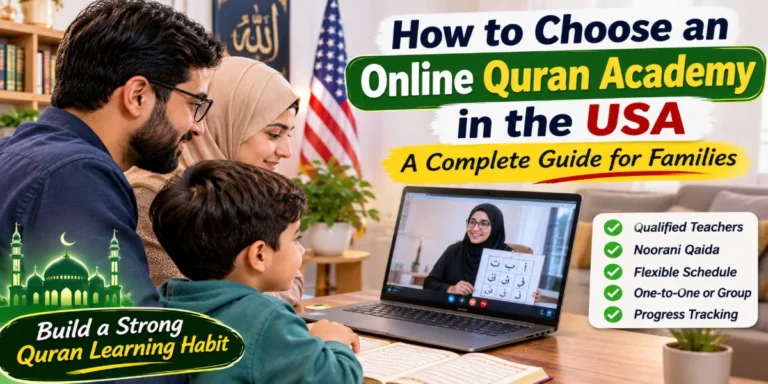
For a lot of Muslim families in America, finding a good Quran teacher used to mean a long drive to the nearest masjid, weekend-only classes, and timings that clashed with school, work and sports practice. That picture has changed. Academies like Online Quran Classes USA, run by Tawhid Academy, now bring a qualified teacher into your living room at a time that actually suits your family.
The hard part today is not finding a class. It is choosing the right one. Some programs are excellent, while others offer little more than a shaky video call and a rushed lesson. If you or your child are starting from the Arabic alphabet, a structured program of online Quran classes for beginners is the safest place to begin, because mistakes in pronunciation that settle in early are hard to undo later.
This guide covers what to check before you enroll, so you can pick a program with confidence instead of finding out three months in that it was the wrong fit.
Why Online Quran Learning Works for American Families
Most families do not struggle with motivation. They struggle with time. Parents work long hours, kids have homework and activities, and the nearest Islamic center may be 30 or 40 minutes away. Online classes remove the commute and let you fit lessons into a normal weekday evening.
There is also a quieter benefit. Many children learn better at home, where they feel relaxed and can focus on one teacher without the distraction of a full classroom. Parents can sit nearby, listen in, and see exactly how their child is progressing.
1Teachers With Real Qualifications
The teacher matters more than anything else on this list. Before you enroll, ask the academy directly:
- Has the teacher studied Tajweed formally, and from whom?
- Do any teachers hold an Ijazah, a certified chain of transmission in Quran recitation?
- Does the teacher have experience with children, adults, or both?
- Can the teacher explain lessons clearly in English?
That last point is easy to overlook. Children raised in the USA think and learn in English. A teacher with perfect recitation who cannot explain a rule in simple English will leave a young student confused and frustrated.
You can also read more about how certified recitation is taught in our online Ijazah course.
2A Clear Learning Path From Day One
A good academy can tell you exactly where your child will start and where they are heading. Quran learning follows a natural order, and skipping steps usually backfires.
A sensible path looks like this:
- Noorani Qaida to learn Arabic letters, sounds and joining rules
- Quran reading with Tajweed to recite correctly and fluently
- Memorization (Hifz) for students ready to commit Surahs or the full Quran to memory
- Tafseer to understand the meaning behind what they recite
Tawhid Academy, for example, lays its courses out in this order, from Noorani Qaida and Tajweed through to Quran memorization, Tafseer and an Ijazah program. Ask any academy you are considering to show you its course outline. If they cannot explain how a student moves from one level to the next, that is a warning sign.
3Class Times That Fit US Time Zones
The USA spans several time zones, and plenty of overseas academies schedule around their own clock rather than yours. Check that the program offers:
- Slots that work for Eastern, Central, Mountain and Pacific time
- After-school and evening classes on weekdays
- Weekend options for busy families
- A fair policy for rescheduling missed classes
Consistency is what builds a strong reader. A class time that fits your routine is one your child will actually show up for.
4One-on-One Attention
Group classes can be cheaper, but Quran recitation is a skill where personal correction makes a huge difference. In a one-on-one session, the teacher hears every letter your child pronounces and fixes mistakes on the spot.
For beginners in particular, one-on-one learning is worth the extra cost. Once a student reads confidently, small group classes for Tafseer or revision can work well.
5Female Teachers for Sisters and Young Girls
Many sisters and parents of young girls prefer a female teacher, and that is a completely reasonable preference. Ask whether the academy has qualified female teachers available and whether you can request one at the time of enrollment rather than being placed on a long waiting list.
Looking for a female tutor? See our online Quran classes for ladies.
6Progress Reports and Parent Involvement
You should never have to guess how your child is doing. A well-run program keeps parents in the loop through regular updates on what was covered, what needs more practice, and how close the student is to moving to the next level.
It also helps when teachers give small practice tasks between classes. Ten minutes of daily revision at home does more for progress than one long class a week.
7A Free Trial Class Before You Commit
A trial class tells you more than any website can. Most reputable academies offer one, and you should use it carefully. During the trial, pay attention to:
- Whether the teacher is patient and encouraging
- How clearly they explain things in English
- Whether they assess your child’s level before teaching
- The audio and video quality of the session
- How your child feels afterward
If your child comes away interested and comfortable, you are on the right track.
8Clear Pricing With No Surprises
Ask for the full picture upfront: the monthly fee, how many classes it covers, how long each class runs, and what happens if you need to pause or cancel. Honest academies are happy to answer these questions. Vague answers or pressure to pay for several months in advance should make you cautious.
Red Flags to Watch Out For
- No information about who the teachers are or how they were trained
- No structured syllabus or level system
- Classes only available at odd hours for US families
- No trial class, or a trial that feels like a sales pitch
- Teachers who rush through recitation without correcting mistakes
- Long-term contracts with no clear cancellation terms
Quick Checklist Before You Enroll
- Teachers are trained in Tajweed and can teach in English
- There is a clear course path from Noorani Qaida upward
- Class times fit your time zone and routine
- One-on-one classes are available
- Female teachers are available if you need one
- Parents receive regular progress updates
- A free trial class is offered
- Pricing and cancellation terms are clear
Frequently Asked Questions
What age can children start online Quran classes?
Most children can start around age 4 or 5. At this age, lessons should be short, usually 20 to 30 minutes, and focus on letters and sounds through Noorani Qaida.
How many classes per week are best for beginners?
Three to five short classes a week usually works best. Frequent, shorter sessions help beginners remember what they learned far better than one long weekly class.
Can adults with no Arabic background learn the Quran online?
Yes, adults can learn from scratch online. Many academies have beginner programs designed for adults who never had the chance to learn as children, and one-on-one classes let them move at their own pace without feeling embarrassed.
How long does it take to read the Quran with Tajweed?
It depends on the student, but many beginners read with basic Tajweed within 6 to 12 months of regular classes. Age, class frequency and daily practice at home all affect the timeline.
Are online Quran classes as effective as in-person classes?
With a qualified teacher and one-on-one sessions, online classes can be just as effective. The key factors are the teacher’s skill, a structured syllabus and consistent attendance, not whether the class happens in person or on a screen.
Final Thoughts
Choosing a Quran program is a long-term decision, so it is worth taking a week to compare options properly. Look for qualified teachers who communicate well in English, a clear path from the basics to advanced study, timings that fit your family, and a trial class that lets you judge for yourself. Tawhid Academy was built around exactly these needs, with one-on-one classes for kids, adults and beginners across the USA and a free trial so families can see the teaching before they commit. Whichever academy you choose, hold it to the checklist above. Your child’s relationship with the Quran deserves a strong start.