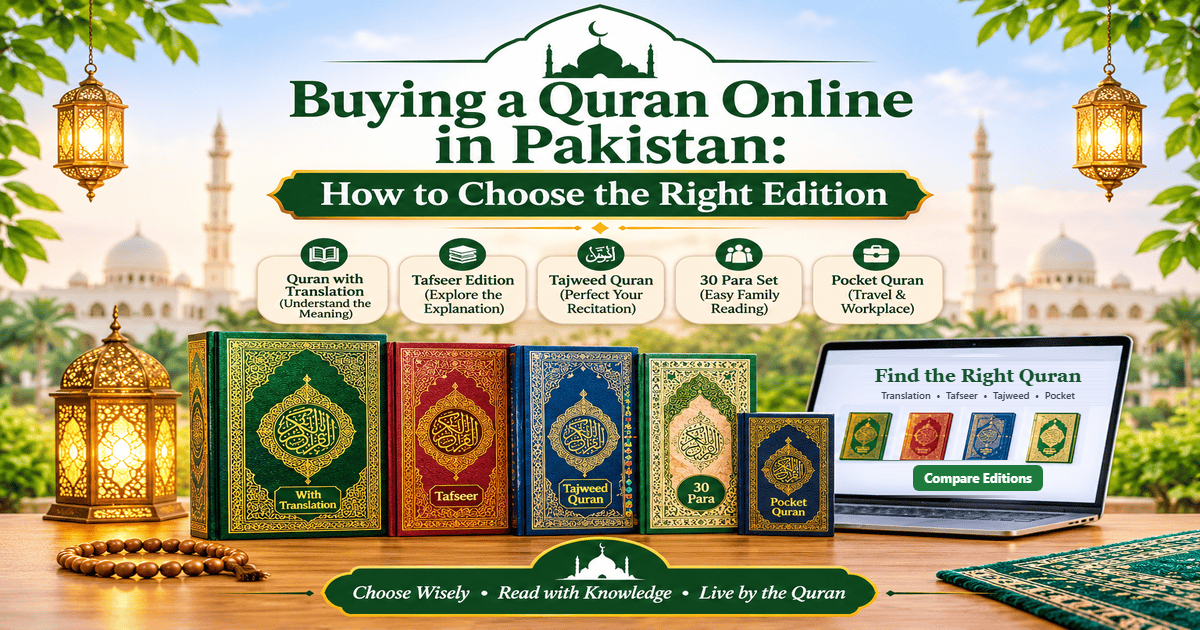
Quick answer: Before you buy a Quran online in Pakistan, decide three things: the script (most Pakistanis learn the Indo-Pak script, not the Arab Uthmani one), the line count (16-line Hafizi for Hifz and daily reading, 13-line or large print for beginners and elders), and the type (plain Arabic, colour-coded Tajweed, Urdu or English translation, or a full Tafseer).
Then order only from a seller who names the publisher, shows real photos of the inside pages, and will replace a copy with a printing fault.
Buying a Quran should be simple, yet many people end up with a copy they cannot read comfortably: the script looks unfamiliar, the text is too small, or the line layout does not match the one their teacher uses. Online listings make this harder, because a cover photo tells you almost nothing about what is inside.
This guide walks you through every choice in the order that matters, so you can order the right Quran the first time, whether it is for yourself, a child starting Hifz, an elderly parent, or a gift.
1. Choose the right script: Indo-Pak or Uthmani
The Quran is printed in two main scripts, and this is the choice people most often get wrong when ordering online.
- Indo-Pak script (also called Persian or Hafizi script) has bolder letters, extra vowel marks and the waqf signs that are taught in Pakistani madaris and Quran classes. If you learned to read with the Noorani Qaida, this is the script you will read most easily.
- Uthmani script is the style printed in Saudi Arabia and most Arab countries. It is beautiful and perfectly correct, but readers from Pakistan often find it harder at first because some vowel marks and letter shapes look different.
If a listing does not say which script it uses, ask before you order. A product title that says “Pakistani script”, “Indo-Pak” or “Hafizi” means Indo-Pak; “Madani” or “Saudi style” usually means Uthmani.
2. Pick the line count that suits the reader
Pakistani Qurans are described by how many lines are printed on each page. The line count changes the size of the text and how the pages are laid out.
| Line count | Best for | Why |
|---|---|---|
| 16-line (Hafizi) | Hifz students, teachers and regular readers | The standard layout in Pakistani madaris. Each para starts and ends at the same place on the page in every copy, which helps memorisation and revision. |
| 15-line | Daily recitation, mosques, gifts | A balanced page with slightly fewer lines; also available in Saudi-style layouts. |
| 13-line | Beginners and children moving on from the Qaida | Larger letters and more space between lines make each word easier to follow. |
| 9 or 11-line large print | Elderly readers and weak eyesight | Very large text with fewer words per page, so the book is thicker and heavier. |
Tip for Hifz students: Always buy the same line count and publisher your teacher uses. Memorisation relies on the position of each ayah on the page, so switching layouts mid-way can slow revision down.
3. Plain Arabic, Tajweed, translation or Tafseer?
Plain Arabic Quran
Only the Arabic text. Ideal for people who already recite fluently and for Hifz, where a clean page is less distracting.
Colour-coded Tajweed Quran
Letters are coloured to show rules such as ghunnah, ikhfa, qalqalah and the different lengths of madd. It is a strong choice if you are correcting your recitation, but the colours only help once you know what each one means. Pair it with a teacher, for example through online Tajweed classes, so the colours turn into correct pronunciation.
Quran with Urdu or English translation
The Arabic text with a word-by-word or line-by-line meaning beside it. This suits anyone who wants to understand what they recite. Popular Urdu translations in Pakistan include Kanzul Iman, Fateh Muhammad Jalandhari, Kanzul Irfan and the translation printed with Ahsan ul Bayan. Each reflects a particular scholarly approach, so choose the one recommended by the scholar or teacher your family follows.
Tafseer
A Tafseer explains the background and meaning of each verse in detail. Well-known Urdu works include Tafheem ul Quran (Maulana Maududi, usually 6 volumes), Tafseer Ahsan ul Bayan (single volume) and Bayan ul Quran (Maulana Ashraf Ali Thanwi). A Tafseer is a study book rather than a daily recitation copy, so most homes keep it alongside a regular Quran.
4. Choose the size and format
- Standard size (about 14 × 21 cm): the everyday copy for home and mosque.
- Large or A4 size: easier on the eyes and comfortable on a rehal (Quran stand).
- Pocket size: for travel, office or Umrah. The text is small, so it works best for people who already read fluently.
- 30 Para set: each para bound separately. Families use it for group khatam, Ramadan reading and Quran Khwani because several people can read at once.
5. What does a Quran cost in Pakistan?
Prices depend on the publisher, paper and binding more than on the text itself. As a rough guide in 2026:
| Type | Typical price range |
|---|---|
| Pocket or basic 16-line Quran | Around Rs 500 to Rs 1,500 |
| Tajweed colour-coded or art paper edition | Around Rs 800 to Rs 3,500 |
| Quran with Urdu translation | Around Rs 1,500 to Rs 4,000 |
| 30 Para set | Around Rs 1,500 to Rs 5,000 |
| Multi-volume Tafseer (for example 6 volumes) | Around Rs 12,000 to Rs 17,000 |
Gift boxes, velvet covers and premium paper can double the price of the same text. If a deluxe-looking copy is far cheaper than similar listings, treat it with caution.
6. Checklist before you place an online order
- Publisher named. A trustworthy listing tells you who printed the Quran. Avoid listings with no publisher at all.
- Real inside photos. Ask for a photo of an open page so you can check the script, line count, text size and print clarity.
- Script and line count stated. Confirm “Indo-Pak” or “Uthmani” and the number of lines in writing before you pay.
- Paper and binding. Art or offset paper and stitched binding last for years; thin newsprint and glued spines wear quickly with daily use.
- Proofreading note. Reputable editions carry the publisher’s details and a proofreading or approval note, usually at the back.
- Replacement for printing faults. Check that the seller will replace a copy with missing, repeated or misprinted pages.
- Payment and delivery. Cash on delivery lets you see the parcel before paying. Check delivery charges, the delivery time to your city, and that the Quran will be packed securely and respectfully.
7. Which Quran should you buy for each person?
- A child who has just finished the Qaida: a 13-line Indo-Pak Quran with clear, large letters. If your child is still on the basics, start with our free Noorani Qaida PDF first.
- A Hifz student: a sturdy 16-line Hafizi copy from the same publisher the teacher uses.
- An adult improving recitation: a colour-coded Tajweed Quran.
- Someone who wants to understand the meaning: a Quran with Urdu or English translation, and later a Tafseer.
- An elderly parent: a large-print 9, 11 or 13-line edition with a rehal.
- A traveller or Umrah pilgrim: a pocket Quran with a zipped or protective cover.
- A gift: a good-quality copy in the reader’s preferred script, with a cover or box, and a translation if the person is still learning.
8. Receiving and caring for your Quran
When the parcel arrives, open it with clean hands, check every page quickly for printing faults, and report any problem to the seller straight away so it can be replaced. Keep the Quran on a high, clean shelf or a rehal, away from damp and direct sunlight, which yellow the pages over time.
If you ever have an old or damaged copy, do not throw it away. Give it to a mosque or a collection point for worn-out Quran pages, or follow your local scholar’s guidance on burying it respectfully.
Frequently asked questions
The 16-line Hafizi Quran in Indo-Pak script is the standard in Pakistani madaris. Buy the same publisher and layout your teacher uses so every page looks the same during revision.
Neither is better in itself. The 16-line copy is the Hifz standard in Pakistan, while the 15-line copy is common for everyday recitation. Choose the one you or your teacher already read from.
Yes, if the seller names the publisher, shows real inside photos and replaces copies with printing faults. Cash on delivery adds extra peace of mind.
A basic or pocket Quran usually costs Rs 500 to Rs 1,500, a Tajweed or translated edition Rs 800 to Rs 4,000, and a multi-volume Tafseer Rs 12,000 or more, depending on paper and binding.
Most Pakistanis learn with the Noorani Qaida and read the Indo-Pak script most comfortably. Choose Uthmani only if you learned with it or want to practise the Arab style.
Contact the seller or publisher for a replacement. Do not discard the faulty copy; hand it to a mosque or a collection point for old Quran pages.