If you’ve been searching for how to learn Quran online, you’ve probably noticed a problem already. There are hundreds of apps, academies, and YouTube channels, and almost none of them tell you where to actually start. This guide fixes that. It walks you through the real process, step by step, so you know exactly what to do first, second, and third.
You don’t need any prior knowledge of Arabic to follow this. We’ll cover how to check your current level, which learning method actually works, what your first class looks like, and how long the whole journey realistically takes.
Key Takeaways
- Your starting point (not the platform you pick) determines how fast you progress.
- Live 1-to-1 correction beats apps for fixing pronunciation, because Tajweed is a spoken skill.
- Most learners follow the same path: Noorani Qaida, then reading, then Tajweed, then optional Hifz.
- A free trial class exists so you can judge fit before spending any money.
- Consistency matters more than class length. Two short sessions a week beats one long session done irregularly.
- Skipping steps, especially jumping to memorization too early, is the top reason learners stall.
What You Actually Need to Get Started
You don’t need special equipment. Most students only need:
- A stable internet connection
- A laptop, tablet, or smartphone
- A printed or digital copy of the Quran
- Headphones with a working microphone, so your tutor can hear your pronunciation clearly
- A quiet spot for your lessons
That’s it. Classes typically run through familiar video-calling tools, so there’s no separate app to learn before you can begin.
Step 1: Find Your Starting Point to Learn Quran Online
Be honest with yourself here. Most people learning Quran online fall into one of three groups.
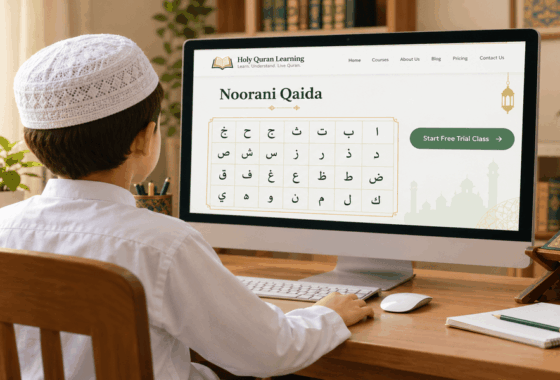
Complete beginners can’t yet recognize Arabic letters or how they join together. You start with Noorani Qaida, the foundational course covering the alphabet and letter sounds.
Basic readers can sound out words but aren’t confident in pronunciation. You move toward a Quran Reading course, then into Tajweed.
Confident readers already read fluently and want to refine Tajweed, start memorizing the Quran (Hifz), or study the meaning of the verses through Tafseer.
Getting this right saves you months. Starting someone on Tajweed rules before they can read comfortably is one of the fastest ways to make them give up.
Step 2: Pick the Right Learning Method
There isn’t one single way to learn Quran online. Three methods dominate, and each has a real trade-off.
Self-study apps and free videos
These are flexible and free, which makes them appealing. But nothing corrects you while you’re speaking. Tajweed is a spoken skill, and a mispronounced letter can go unnoticed for months without someone listening in real time.
Group online classes
Group classes cost less than 1-to-1 lessons and work well for subjects like Islamic Studies. The catch is limited individual feedback. In a class of six or eight, each student might get only a couple of minutes of direct correction per session.
1-to-1 live tutoring
A tutor listens to every word and corrects mistakes as they happen. This is how Tajweed has been taught for generations, through direct spoken correction from a qualified teacher. It costs more than an app, but it’s far more likely to actually fix pronunciation instead of letting errors turn into habits.
If your real goal is correct recitation, not just following along, live correction is hard to replace. Most academies, including ours, offer a free trial class so you can experience 1-to-1 correction before deciding if it’s right for you.
Correct pronunciation isn’t just a technical nicety, either. According to IslamWeb, a mispronounced letter in the Quran can genuinely change the meaning of a word, which is exactly why Tajweed is treated as essential rather than optional once you move past the basics.
Step 3: Follow the Standard Learning Path
Most structured Quran programs, free or paid, follow roughly the same sequence.
- Noorani Qaida — Arabic letters, sounds, and joined forms. Usually takes one to three months.
- Basic Quran Reading — reading directly from the Mushaf, word by word, with correction.
- Tajweed rules — the why behind pronunciation: elongation, nasalization, stopping rules, and more.
- Hifz (memorization) — for learners continuing on to memorize Surahs or the full Quran.
- Tafseer and Translation — optional, for understanding meaning.
The Quran itself is organized into 114 chapters, or surahs, of varying length. Knowing that structure helps early on, since your tutor will likely start you on short, easy surahs before moving to longer ones.
Skipping ahead, especially jumping into memorization before your Tajweed is solid, means unlearning bad habits later. That almost always takes longer than doing it right the first time.
Step 4: Know What Your First Class Looks Like
Nearly every academy offers a free trial class before you commit to anything. Here’s what usually happens.
- The tutor asks you to read or recite something simple to assess your level.
- They recommend a course: Qaida, Reading, or Tajweed, based on that assessment.
- You get a short sample lesson so you can judge teaching style and pace.
- You discuss scheduling, since students are often spread across different time zones.
There’s no cost or obligation at this stage. It exists purely so you can judge fit before paying for anything.
Step 5: Choose the Right Tutor
A few practical things worth checking before you commit to regular classes:
- Qualification. Look for tutors who are Hafiz or Hafiza (have memorized the Quran) or hold a formal Ijazah in Tajweed or recitation.
- Gender preference. Many students, especially women and young girls, prefer a female tutor. Reputable academies offer this as a standard option.
- Teaching pace. Ask whether the tutor adjusts pace to the student, rather than running a fixed curriculum regardless of progress.
- Try more than one tutor if you can. Teaching style matters as much as qualification. A tutor who’s a great fit for one student might not suit another at all.
Quran Learning for Kids vs. Adults
The core path is the same for both, but the experience differs in a few practical ways.
For children, most academies start around ages four to six, once a child can sit through a short structured lesson. Sessions tend to be shorter, more interactive, and combined with basic Islamic manners and short duas alongside letter recognition. Parents can usually sit in on lessons, which many find reassuring.
For adults, there’s no upper age limit, and no “too late.” Adults often move faster through Noorani Qaida since focus and discipline come more naturally, but may feel more self-conscious about mistakes early on. A patient tutor who doesn’t rush this stage makes a real difference.
Can You Learn the Quran Without a Teacher?
Technically, yes, using free apps, YouTube channels, or self-study books. But it comes with real limits worth being honest about.
Self-study can teach you vocabulary, familiarize you with the shape of the text, and help with revision once you already read reasonably well. What it can’t do is catch a mispronounced letter the moment it happens. Since Tajweed is fundamentally about spoken correction, most students who try to learn entirely alone end up developing habits a live tutor later has to unlearn with them, which takes longer than starting with a tutor in the first place.
A reasonable middle ground: use free resources for extra practice and revision between live lessons, not as a replacement for them.
Common Challenges and How to Fix Them
| Challenge | What Actually Helps |
|---|---|
| Busy schedule | Choose flexible class timings and split practice into short daily sessions instead of one long one. |
| Struggling with pronunciation | Ask your tutor to slow down and repeat the specific letter or rule until it clicks, rather than moving on. |
| Forgetting previous lessons | Spend 5–10 minutes reviewing the last lesson before starting a new one. |
| Losing motivation partway through | Set small monthly goals (one Surah, one Tajweed rule) instead of vague long-term ones. |
| Feeling embarrassed about mistakes | Remember every student, including experienced reciters, made the same mistakes early on. A good tutor treats this as normal, not something to be self-conscious about. |
How Long Does It Actually Take?
Progress depends on age, consistency, and any prior exposure to Arabic. These are rough benchmarks, not guarantees.
| Stage | Typical Timeframe |
|---|---|
| Learning the Arabic alphabet | 2–4 weeks |
| Reading slowly, without full fluency | 1–3 months |
| Reading fluently with correct Tajweed | 6 months to 1.5 years |
| Memorizing short Surahs | Ongoing, alongside reading practice |
| Full Hifz (memorizing the entire Quran) | 2–5 years |
These numbers assume regular practice, two to five sessions a week. Inconsistent attendance is the single biggest reason these timelines stretch out.
Common Mistakes When You Learn Quran Online
- Starting memorization before reading is solid. Verses memorized with incorrect Tajweed are harder to fix later than if you’d waited.
- Relying only on apps for pronunciation. Apps are great for revision and vocabulary, but they can’t correct your spoken Tajweed.
- Inconsistent scheduling. Two short weekly sessions, done consistently, beat one long session done irregularly.
- Staying quiet during class. A good tutor expects and welcomes questions about pronunciation. Hesitating to ask slows you down.
Why This Matters Beyond Just Reading
Learning to recite the Quran isn’t just about literacy, and it isn’t a race against other students. The Prophet Muhammad (ﷺ) is reported to have said, “The best among you are those who learn the Quran and teach it,” a hadith recorded in Sahih al-Bukhari. Progress is a lifelong practice, built gradually, the same way it has been taught for over a thousand years.
Final Thoughts
The honest starting point for almost every adult or child beginner is the same: a short assessment with a real tutor, so you know exactly where to begin instead of guessing. HolyQuranLearning offers this as a free trial with no obligation to continue.
If you’re ready to find your starting level and meet a tutor, you can book a free trial class with a qualified male or female teacher at a time that suits you.
People Also Ask
Can I learn Quran online without any prior knowledge of Arabic? Yes. Complete beginners start with Noorani Qaida, which teaches Arabic letters and sounds from scratch. No prior knowledge is assumed or needed.
Is it better to learn Quran online through an app or a live tutor? Apps work well for revision and vocabulary practice, but they can’t correct spoken pronunciation in real time. A live tutor can hear mistakes as they happen and correct them immediately, which matters most for Tajweed.
How long does it take to learn to read the Quran fluently? Most learners reach fluent reading with correct Tajweed somewhere between six months and a year and a half, assuming consistent practice of two to five sessions a week.
What is Tajweed, and why does it matter? Tajweed is the set of rules governing how Quranic Arabic should be pronounced, including elongation, nasalization, and stopping points. It matters because correct pronunciation changes both the sound and, in some cases, the meaning of a recitation.
Do I need a male or female tutor? Either works, and it comes down to personal preference. Many women and young girls prefer a female tutor, and most academies offer this as a standard option rather than a special request.
What age should a child start learning the Quran? There’s no fixed rule, but many academies start children around ages four to six with Noorani Qaida, once they can sit through a short structured lesson.
How many days a week should I take classes? Most students attend two to five sessions a week. More frequent, shorter sessions tend to build stronger habits than one long weekly class.
Can I really learn the Quran online without ever attending a physical mosque or madrassa? Yes. Many students worldwide complete their entire Quran education online, from Noorani Qaida through to Hifz, without ever attending an in-person class, as long as they’re consistent and working with a qualified tutor.