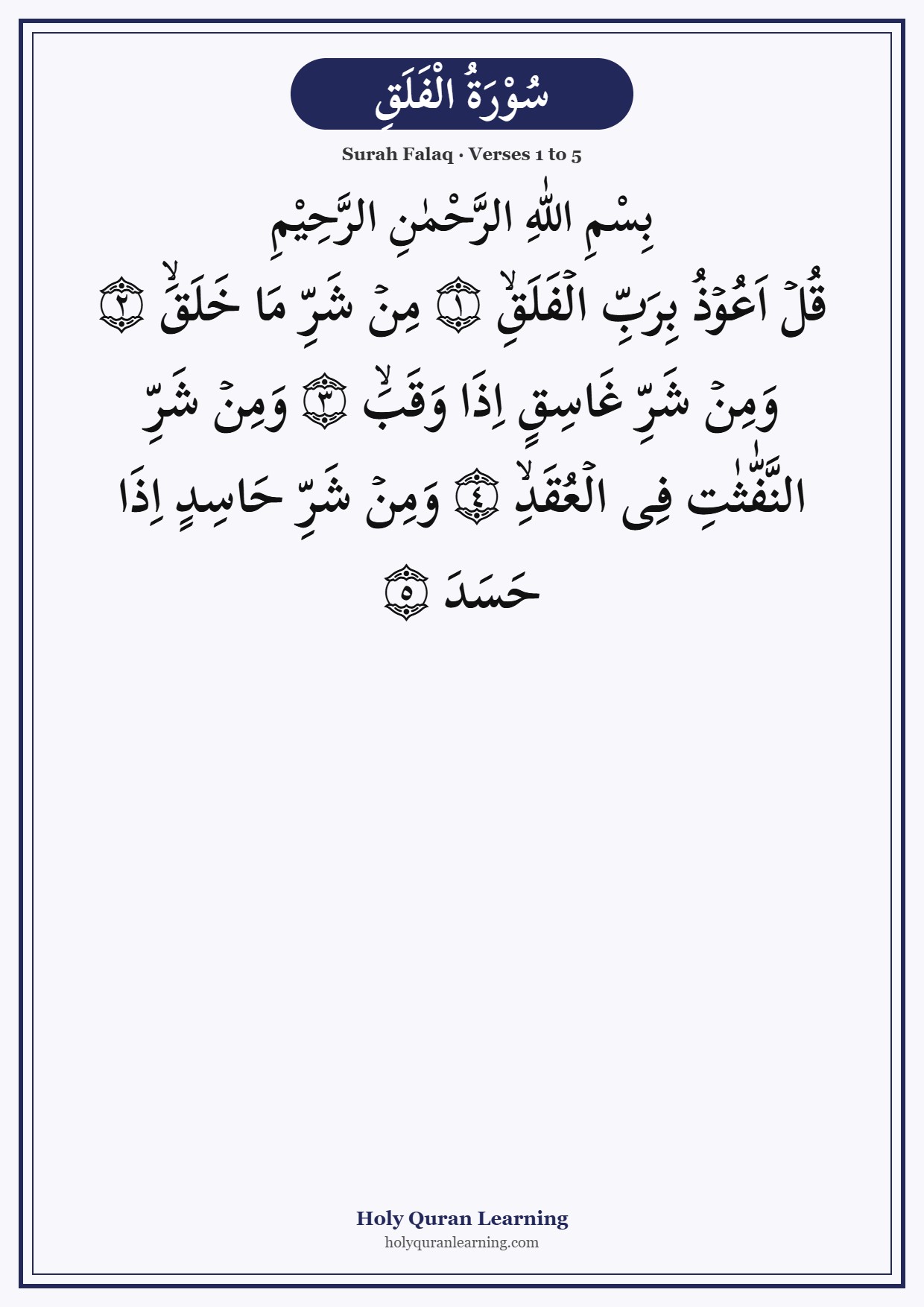
Surah Falaq Full Image
The complete Surah Falaq in bold, clear Indo-Pak Arabic script with every waqf (stop) sign. Save the images to your phone and read even when you are offline.
Surah Falaq with Urdu and English Translation
Each verse shows the Arabic text, Roman transliteration, English translation and Urdu translation (اردو ترجمہ). Use the buttons to show or hide each language.
بِسْمِ ٱللَّهِ ٱلرَّحْمَٰنِ ٱلرَّحِيمِ
قُلۡ اَعُوۡذُ بِرَبِ͏ّ الۡفَلَقِۙ1
Qul a’oothu birabbi alfalaq
1. Say: I seek refuge in the Lord of the Daybreak
کہو کہ میں صبح کے پروردگار کی پناہ مانگتا ہوں
مِنۡ شَرِ͏ّ مَا خَلَقَۙ2
Min sharri ma khalaq
2. From the evil of that which He created;
ہر چیز کی بدی سے جو اس نے پیدا کی
وَمِنۡ شَرِ͏ّ غَاسِقٍ اِذَا وَقَبَۙ3
Wamin sharri ghasiqin ithawaqab
3. From the evil of the darkness when it is intense
اور شب تاریکی کی برائی سے جب اس کااندھیرا چھا جائے
وَمِنۡ شَرِ͏ّ النَّفّٰثٰتِ فِى الۡعُقَدِۙ4
Wamin sharri annaffathatifee al’uqad
4. And from the evil of malignant witchcraft
اور گنڈوں پر (پڑھ پڑھ کر) پھونکنے والیوں کی برائی سے
وَمِنۡ شَرِ͏ّ حَاسِدٍ اِذَا حَسَدَ5
Wamin sharri hasidin itha hasad
5. And from the evil of the envier when he envieth.
اور حسد کرنے والے کی برائی سے جب حسد کرنے لگے
Arabic text: Indo-Pak script with waqf signs. English translation: Marmaduke Pickthall. Urdu translation: Fateh Muhammad Jalandhry. Transliteration: Tanzil.
Surah Al Falaq · Sheikh Mishary Rashid Alafasy
Full recitation. To follow verse by verse, open Text + Translation.
Surah Falaq PDF Download (Free)
Three free PDF versions, hosted on this website with no redirects. Each prints cleanly on A4 paper.
Read Surah Falaq: Text with Translation, Audio, Images or PDF
Tap any verse to hear that verse recited by Sheikh Mishary Rashid Alafasy, then tap again to stop. Choose how you want to read Surah Falaq. Images show the full surah in bold Indo-Pak script with waqf signs. Text shows every verse with transliteration, English and Urdu translation, and PDF gives you three free downloads.
Surah Falaq (سورۃ الفلق, Surah Al Falaq) is the 113th chapter of the Quran. In its 5 verses we ask Allah, the Lord of the daybreak, to protect us from harm: darkness, magic and envy. Together with Surah An Nas it forms the Muawwidhatain, the two surahs of refuge. The Prophet ﷺ recited them every morning, evening and night.
Below you can read Surah Falaq in Arabic with Urdu and English translation. You can learn its word by word meaning and tafseer, and follow the Sunnah bedtime routine with your children. You can also download the free PDF.
سُورَةُ الْفَلَق
Surah Al Falaq · Chapter 113 · 5 verses · Para 30
Listen to Surah Falaq (Audio Recitation)
Press play and follow the text above. Listening while you read is the fastest way to improve pronunciation and start memorising.
Surah Falaq Word by Word Meaning
| Arabic | Transliteration | Meaning |
|---|---|---|
| قُلۡ اَعُوۡذُ | Qul a’udhu | Say, I seek refuge |
| بِرَبِ͏ّ الۡفَلَقِ | bi rabbil falaq | in the Lord of the daybreak |
| مِنۡ شَرِ͏ّ مَا خَلَقَ | min sharri ma khalaq | from the evil of what He created |
| وَمِنۡ شَرِ͏ّ غَاسِقٍ | wa min sharri ghasiqin | and from the evil of darkness |
| اِذَا وَقَبَ | idha waqab | when it settles |
| وَمِنۡ شَرِ͏ّ النَّفّٰثٰتِ | wa min sharrin naffathati | and from the evil of the blowers |
| فِى الۡعُقَدِ | fil ‘uqad | in knots |
| وَمِنۡ شَرِ͏ّ حَاسِدٍ | wa min sharri hasidin | and from the evil of an envier |
| اِذَا حَسَدَ | idha hasad | when he envies |
Tafseer of Surah Al Falaq, Verse by Verse
- Verse 1: The Lord of the daybreak. Ibn Abbas and Mujahid said al falaq is the daybreak, the dawn that splits the darkness. Allah calls Himself “the Cleaver of the daybreak” in 6:96.
- Verse 2: The evil of all creation. We seek refuge from the harm of everything Allah created that can cause harm, including Shaytan and Hellfire. Thabit al Bunani and al Hasan explained it this way.
- Verse 3: Darkness when it settles. Most mufassirun say ghasiq is the night when it becomes dark, because harmful things spread at night.
- Verse 4: Those who blow on knots. Mujahid, Ikrimah and Qatadah said this refers to magicians who tie knots and blow on them.
- Verse 5: The envier when he envies. Envy (hasad) and the evil eye harm others, so we ask Allah to protect us from them.
Background of revelation
Aisha reported that Labid ibn al A’sam performed magic on the Prophet ﷺ. He used a comb and hair hidden in the well of Dharwan. Allah showed the Prophet ﷺ where it was (Bukhari 5763). The popular story of “eleven knots for eleven verses” comes from weak reports. We do not present it as authentic. Uqbah ibn Amir reported that the Prophet ﷺ said: “Verses have been revealed to me tonight, the like of which has never been seen,” meaning Al Falaq and An Nas (Muslim 814).
Authentic Benefits of Surah Falaq
Surah Falaq is also a key part of protection from nazar. Read our guide to the authentic nazar ki dua for the full family routine.
The Sunnah Bedtime Routine with Surah Falaq
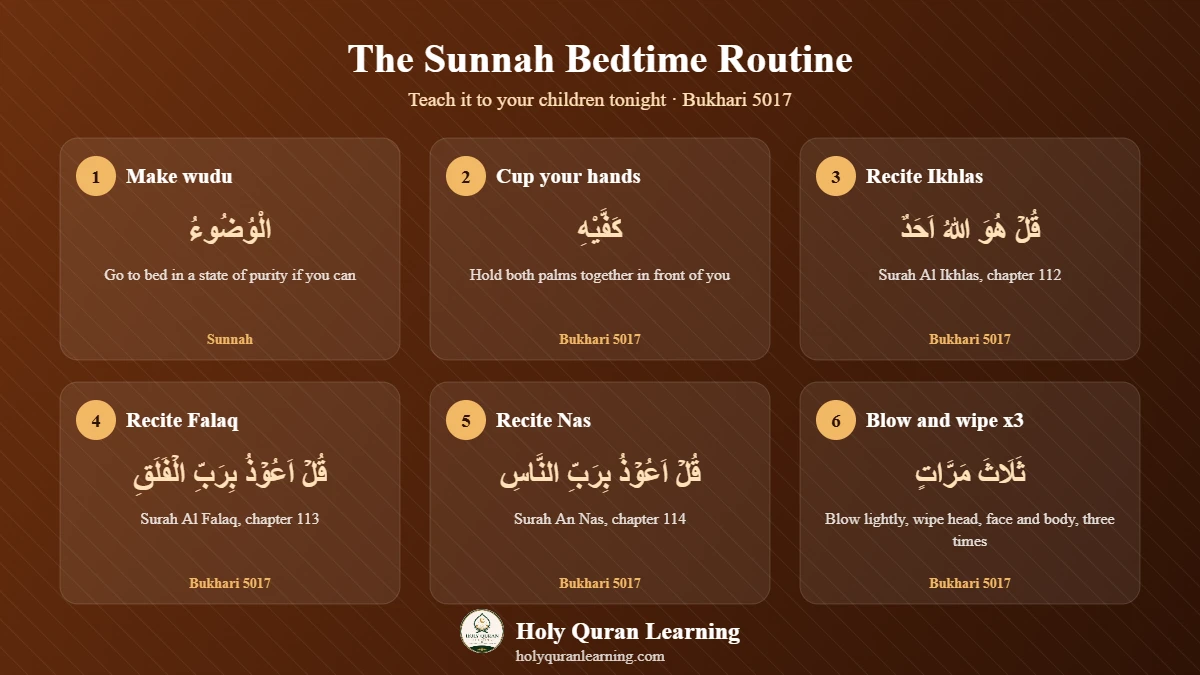
- Make wudu before bed if you can.
- Cup your hands together in front of your face.
- Recite Surah Al Ikhlas, Surah Al Falaq and Surah An Nas.
- Blow lightly into your hands.
- Wipe over your head, face and as much of your body as you can reach.
- Repeat three times, just as the Prophet ﷺ did (Bukhari 5017).
Teach Surah Falaq to Your Children
Surah Falaq has five short verses, so most children learn it in a week. Learn one verse a day with the audio, then recite all five together on the weekend. Watch for two Tajweed points. The first is the qalqalah bounce on the qaf in al falaq and on the ba in waqab. The second is the ghunnah in an naffathati. Our guide to Tajweed rules with simple examples explains both. A teacher can correct small mistakes before they become habits.
Want your child to recite the three Quls perfectly? Our one to one online Quran classes for kids start with Juz Amma and correct Tajweed from the first lesson. Adults can join our Quran classes for adults. Free trial included.
Surah Falaq: Frequently Asked Questions
What is the meaning of Surah Falaq?
Al Falaq means “the Daybreak”. In this surah we seek refuge in the Lord of the daybreak. We ask for protection from the evil of His creation and the darkness of night. We also seek refuge from those who blow on knots (magic) and from the envier when he envies.
How many verses are in Surah Falaq?
Surah Al Falaq has 5 verses. It is the 113th surah of the Quran and is in Para 30 (Juz Amma).
Is Surah Falaq Makki or Madani?
The majority view, from Ibn Abbas, al Hasan and Ikrimah, is that it is Makki. Others consider it Madani because of reports linking it to the magic done against the Prophet ﷺ in Madinah.
What are the Muawwidhatain?
The Muawwidhatain are Surah Al Falaq and Surah An Nas, the “two surahs of seeking refuge”. The Prophet ﷺ said nothing like them has been revealed (Sahih Muslim 814).
How many times should I read Surah Falaq in the morning and evening?
Recite Surah Al Ikhlas, Al Falaq and An Nas three times each in the morning and evening. The Prophet ﷺ said they will suffice you against everything (Abu Dawud 5082).
Does Surah Falaq protect from black magic and the evil eye?
Seeking refuge with Allah through Al Falaq and An Nas is Sunnah for protection from magic, envy and the evil eye. The Prophet ﷺ used them for ruqyah and stopped using other words of refuge once they were revealed (Tirmidhi 2058).
What does “naffathati fil uqad” mean?
It means “those who blow on knots”, referring to people who practise magic by tying knots and blowing on them. Mujahid, Ikrimah and Qatadah explained it this way.
Sources: Quran 113 · Muslim 814 · Abu Dawud 5082 · Bukhari 5017 · Bukhari 5016 · Abu Dawud 1523 · Tirmidhi 2058 · Tafsir Ibn Kathir on Surah 113
More Surahs to Read, Listen to and Download
Looking for daily duas too? Read Safar Ki Dua, Nazar Ki Dua and the 99 Names of Allah, or browse all Quran surahs.
What is the difference between Surah Falaq and Surah Naas?
Surah Al Falaq seeks refuge from outside harms like darkness, magic and envy. Surah An Naas seeks refuge from the whispering of Shaytan inside the heart. Together they are called Al Muawwidhatayn.
When should I recite Surah Falaq before sleeping?
Recite Al Ikhlas, Al Falaq and An Naas into your hands, then wipe over your body. Do this three times before sleeping, as the Prophet ﷺ did (Sahih al Bukhari 5017).
What Is Ghasiq: Darkness or the Moon?
In ayah 3 we seek refuge “from the evil of darkness when it settles” (ghasiqin idha waqab). Aisha (may Allah be pleased with her) reported that the Prophet ﷺ looked at the moon and said: “Seek refuge with Allah from the evil of this, for it is the ghasiq when it sets” (Jami at Tirmidhi 3366). Al Falaq itself means the daybreak, and Rabb al Falaq is the Creator who splits the night with the dawn.
Surah Al Falaq and Surah An Naas: The Two Protectors
Surah Al Falaq (113) and Surah An Naas (114) are called Al Muawwidhatayn, the two surahs of seeking refuge. Both are in Para 30. The Prophet ﷺ said: “Nothing like them has ever been revealed” (Sahih Muslim 814). Al Falaq seeks refuge from outside harms such as darkness, magic and envy. An Naas seeks refuge from the whisperer inside the heart.
Surah Falaq and Protection From Sihr (Magic)
Sahih al Bukhari 5763 records that magic was done on the Prophet ﷺ by a man named Labid ibn al Asam. Allah cured him, and scholars explain that the Muawwidhatayn were recited for protection and healing. The words “from the evil of those who blow on knots” (113:4) refer to magicians.
Recite Before Sleeping
Every night before sleeping, the Prophet ﷺ would blow into his hands and recite Al Ikhlas, Al Falaq and An Naas. Then he would wipe over his body three times (Sahih al Bukhari 5017).
Read the full nazar ki dua guide for more protection duas.