Dua e Qunoot in Arabic, English and Urdu
This is the dua e qunoot recited in most mosques in Pakistan, India and the UK. Tap the buttons to show or hide each language, or copy the text you need.
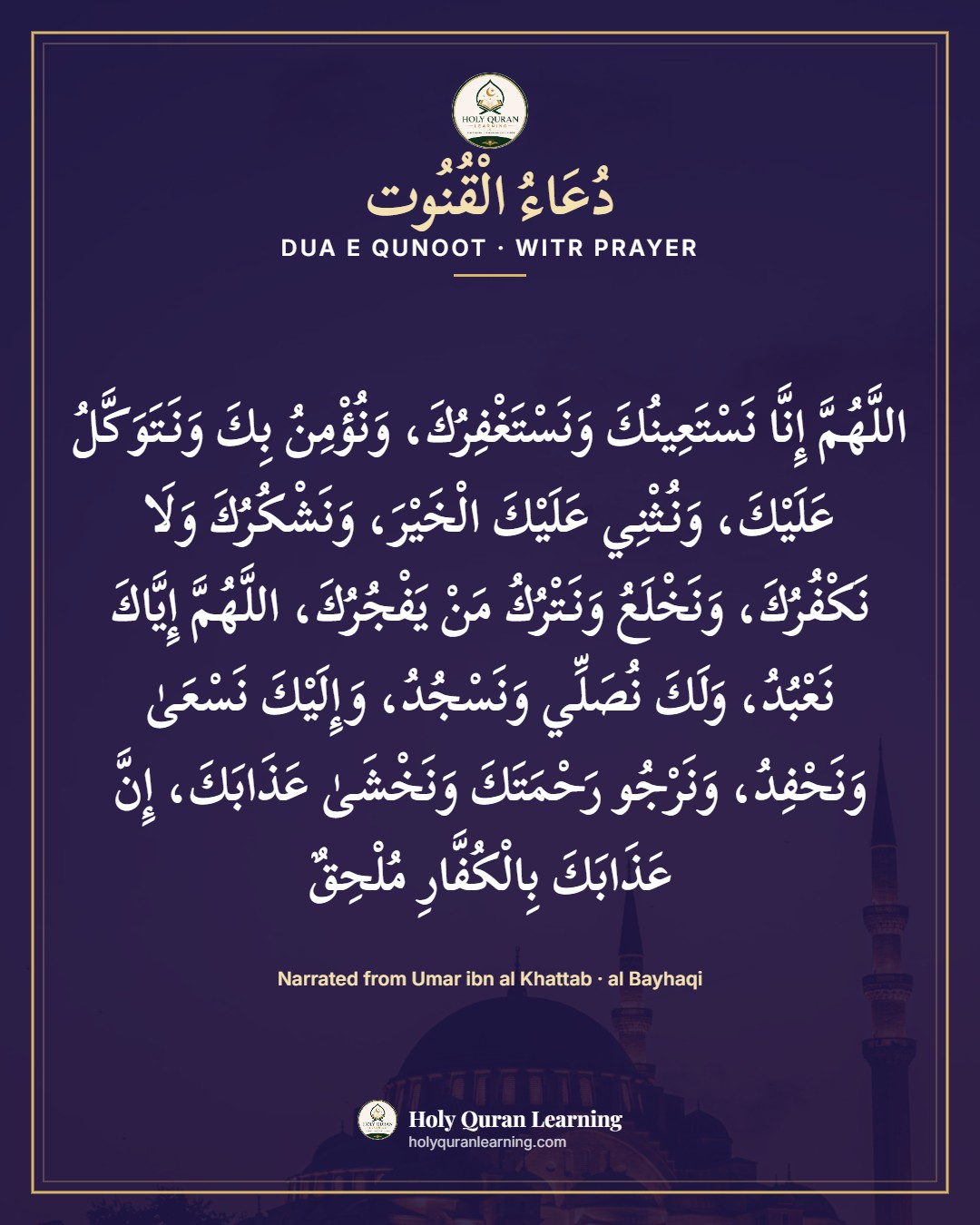
اللَّهُمَّ إِنَّا نَسْتَعِينُكَ وَنَسْتَغْفِرُكَ، وَنُؤْمِنُ بِكَ وَنَتَوَكَّلُ عَلَيْكَ، وَنُثْنِي عَلَيْكَ الْخَيْرَ، وَنَشْكُرُكَ وَلَا نَكْفُرُكَ، وَنَخْلَعُ وَنَتْرُكُ مَنْ يَفْجُرُكَ، اللَّهُمَّ إِيَّاكَ نَعْبُدُ، وَلَكَ نُصَلِ͏ّي وَنَسْجُدُ، وَإِلَيْكَ نَسْعَىٰ وَنَحْفِدُ، وَنَرْجُو رَحْمَتَكَ وَنَخْشَىٰ عَذَابَكَ، إِنَّ عَذَابَكَ بِالْكُفَّارِ مُلْحِقٌ
Allahumma inna nasta’inuka wa nastaghfiruka, wa nu’minu bika wa natawakkalu ‘alayka, wa nuthni ‘alaykal khayr, wa nashkuruka wa la nakfuruka, wa nakhla’u wa natruku man yafjuruk. Allahumma iyyaka na’budu, wa laka nusalli wa nasjudu, wa ilayka nas’a wa nahfidu, wa narju rahmataka wa nakhsha ‘adhabaka, inna ‘adhabaka bil kuffari mulhiq.
O Allah, we ask You for help and seek Your forgiveness, we believe in You and rely on You, we praise You with all good, we thank You and are not ungrateful to You, and we cast off and leave whoever disobeys You. O Allah, You alone we worship, to You we pray and prostrate, towards You we strive and hasten, we hope for Your mercy and fear Your punishment. Surely Your punishment will reach the disbelievers.
اے اللہ! ہم تجھ سے مدد مانگتے ہیں اور تجھ سے بخشش چاہتے ہیں، تجھ پر ایمان لاتے ہیں اور تجھ پر بھروسہ کرتے ہیں، تیری بہترین تعریف کرتے ہیں، تیرا شکر کرتے ہیں اور تیری ناشکری نہیں کرتے، اور جو تیری نافرمانی کرے اسے ہم چھوڑ دیتے ہیں اور اس سے الگ ہو جاتے ہیں۔ اے اللہ! ہم تیری ہی عبادت کرتے ہیں، تیرے ہی لیے نماز پڑھتے اور سجدہ کرتے ہیں، تیری ہی طرف دوڑتے اور لپکتے ہیں، تیری رحمت کی امید رکھتے ہیں اور تیرے عذاب سے ڈرتے ہیں، بے شک تیرا عذاب کافروں کو پہنچنے والا ہے۔
Reported from Umar ibn al Khattab by al Bayhaqi (al Sunan al Kubra 2/210) and Ibn Abi Shaybah, and graded sahih by al Bayhaqi. This is the qunoot most Muslims in Pakistan, India and the UK learn first.
Dua e qunoot is the supplication recited in the third rak’ah of the witr prayer. The version most Muslims in Pakistan, India and the UK learn begins “Allahumma inna nasta’inuka wa nastaghfiruka”, narrated from Umar ibn al Khattab. A second authentic dua qunoot, “Allahummahdini fiman hadayt”, was taught by the Prophet ﷺ to his grandson al Hasan (Abu Dawud 1425).
Below you will find both versions in Arabic, Roman English, English and Urdu with copy buttons, a step by step guide to praying witr with qunoot, the difference between the madhhabs, and what to do if you have not memorised it yet or forget it in salah.
دُعَاءُ الْقُنُوت
Dua e Qunoot · Witr prayer · 2 authentic versions
Dua qunoot at a glance
- Recited in the third rak’ah of witr, after Isha.
- Hanafi: wajib, before ruku, after raising the hands with Allahu Akbar.
- Shafi’i and Hanbali: sunnah, usually after rising from ruku.
- Two authentic texts: “Allahumma inna nasta’inuka” and “Allahummahdini fiman hadayt”.
- Don’t know it yet? Recite “Rabbana atina…” until you memorise it.
- Forgot it in Hanafi witr? Complete the prayer with sajda sahw.
The word mulhiq at the end means “will reach” or “will overtake.” Some scholars read it as mulhaq; both readings are reported.
Dua e Qunoot Image
Save this dua e qunoot image to your phone and practise a line a day. The Arabic is printed in large, bold script so every vowel mark is easy to see.
Dua Qunoot Taught to Hasan ibn Ali (Second Version)
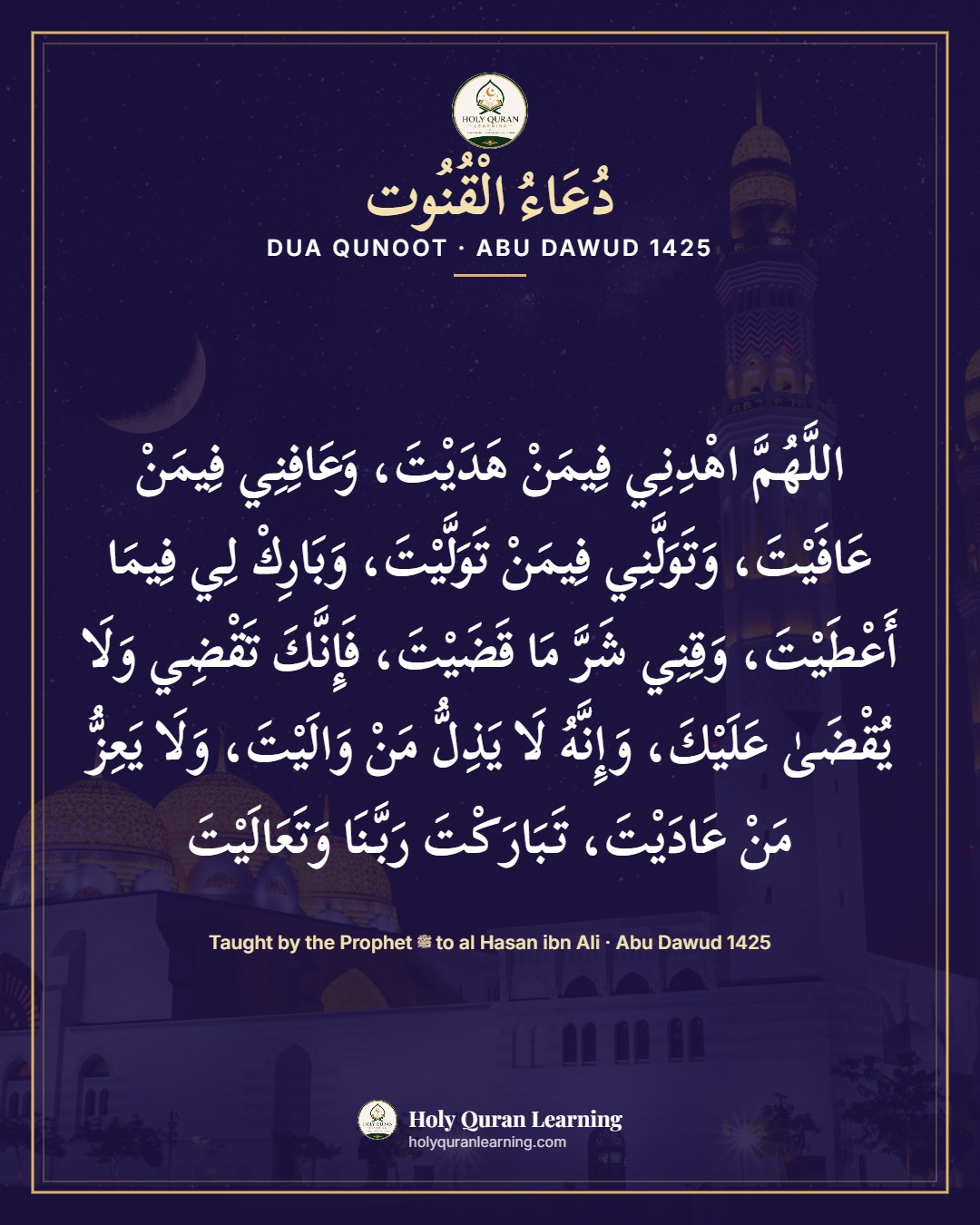
Al Hasan ibn Ali said: “The Messenger of Allah ﷺ taught me words to say in witr.” This dua qunoot is the one most Arabs and followers of the Shafi’i and Hanbali schools recite, and many Hanafis add it after the first version.
اللَّهُمَّ اهْدِنِي فِيمَنْ هَدَيْتَ، وَعَافِنِي فِيمَنْ عَافَيْتَ، وَتَوَلَّنِي فِيمَنْ تَوَلَّيْتَ، وَبَارِكْ لِي فِيمَا أَعْطَيْتَ، وَقِنِي شَرَّ مَا قَضَيْتَ، فَإِنَّكَ تَقْضِي وَلَا يُقْضَىٰ عَلَيْكَ، وَإِنَّهُ لَا يَذِلُّ مَنْ وَالَيْتَ، وَلَا يَعِزُّ مَنْ عَادَيْتَ، تَبَارَكْتَ رَبَّنَا وَتَعَالَيْتَ
Allahummahdini fiman hadayt, wa ‘afini fiman ‘afayt, wa tawallani fiman tawallayt, wa barik li fima a’tayt, wa qini sharra ma qadayt, fa innaka taqdi wa la yuqda ‘alayk, wa innahu la yadhillu man walayt, wa la ya’izzu man ‘adayt, tabarakta rabbana wa ta’alayt.
O Allah, guide me among those You have guided, grant me well being among those You have granted well being, take me into Your care among those You have taken into Your care, bless me in what You have given me, and protect me from the evil of what You have decreed. For You decree and none can decree against You. Whoever You befriend is never humbled, and whoever You oppose is never honoured. Blessed are You, our Lord, and Exalted.
اے اللہ! مجھے ہدایت دے ان لوگوں میں جنہیں تو نے ہدایت دی، مجھے عافیت دے ان لوگوں میں جنہیں تو نے عافیت دی، میری سرپرستی فرما ان لوگوں میں جن کی تو نے سرپرستی فرمائی، جو کچھ تو نے مجھے دیا اس میں برکت دے، اور جو تو نے فیصلہ کیا اس کے شر سے مجھے بچا، بے شک تو ہی فیصلہ کرتا ہے اور تیرے خلاف فیصلہ نہیں کیا جا سکتا، جسے تو دوست رکھے وہ ذلیل نہیں ہوتا، اور جس سے تو دشمنی رکھے وہ عزت نہیں پاتا، اے ہمارے رب! تو بڑا بابرکت اور بلند ہے۔
The Prophet ﷺ taught these words to his grandson al Hasan to say in witr. Graded sahih by al Albani. The line “wa la ya’izzu man ‘adayt” appears in some chains, including al Bayhaqi.
Word by Word Meaning of Dua e Qunoot
| Arabic | Meaning |
|---|---|
| نَسْتَعِينُكَ وَنَسْتَغْفِرُكَ | We ask Your help and seek Your forgiveness |
| وَنُؤْمِنُ بِكَ وَنَتَوَكَّلُ عَلَيْكَ | We believe in You and rely on You |
| وَنُثْنِي عَلَيْكَ الْخَيْرَ | We praise You with all good |
| وَنَخْلَعُ وَنَتْرُكُ مَنْ يَفْجُرُكَ | We cast off and leave whoever disobeys You |
| إِلَيْكَ نَسْعَىٰ وَنَحْفِدُ | Towards You we strive and hasten |
| إِنَّ عَذَابَكَ بِالْكُفَّارِ مُلْحِقٌ | Surely Your punishment will reach the disbelievers |
How to Pray Witr with Dua e Qunoot (Hanafi Method)
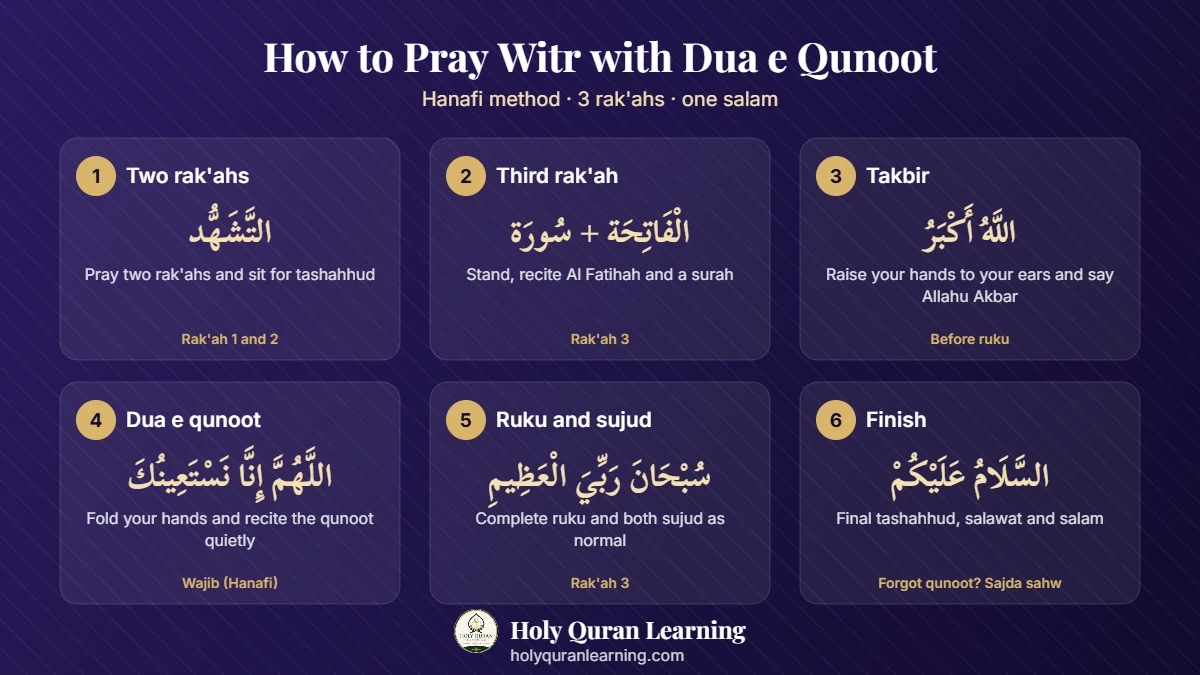
Witr is prayed after Isha and before Fajr. In the Hanafi school it is three rak’ahs with one salam, and dua e qunoot is said in the third rak’ah.
- First two rak’ahs. Pray them as normal, reciting Al Fatihah and a surah in each, then sit for tashahhud.
- Stand for the third rak’ah. Recite Al Fatihah and another surah.
- Say Allahu Akbar. Raise your hands to your ears as in the opening takbir.
- Fold your hands again. Place them below the navel as before.
- Recite dua e qunoot. Say it quietly: “Allahumma inna nasta’inuka…”
- Complete the prayer. Go into ruku, sujud, the final tashahhud and salam.
Shafi’i and Hanbali method
In these schools witr may be one, three or more rak’ahs. In the last rak’ah, after rising from ruku and saying “Rabbana lakal hamd,” raise your hands with palms facing up and recite the dua qunoot of al Hasan, then go into sujud. Shafi’is recite it in witr during the second half of Ramadan, and also in Fajr.
Before or After Ruku? Dua Qunoot in the Four Madhhabs
| School | Qunoot in witr | Position | Qunoot in Fajr |
|---|---|---|---|
| Hanafi | Wajib, all year | Before ruku | No (nazilah only) |
| Shafi’i | Sunnah, second half of Ramadan | After ruku | Sunnah, every day |
| Hanbali | Sunnah, all year | After ruku (before is allowed) | No (nazilah only) |
| Maliki | Not the usual practice | Before ruku in Fajr | Recommended, silently |
These differences come from different authentic narrations, so none of them is wrong. Follow the school you were taught, or the practice of your local masjid when praying in congregation.
Dua e Qunoot PDF Download
Print this free dua e qunoot PDF and keep it next to your prayer mat while you memorise. It has both versions in large, bold Arabic with Roman English, English and Urdu, plus the witr steps.
Short Dua Qunoot: If You Don’t Know It Yet
Many new Muslims and children cannot recite dua e qunoot yet. Hanafi scholars say any dua fulfils the wajib in the meantime. Choose one of these until you have memorised it:
Learning the full dua takes most people less than two weeks if they recite one line after every Isha. If you want a teacher to check your pronunciation, our online Quran classes for adults include daily duas, and our Tajweed guide explains the sounds that are hardest for beginners.
Forgot Dua Qunoot in Witr?
In the Hanafi school, if you forget dua e qunoot and remember only after bowing into ruku, do not stand up again. Continue the prayer and perform sajda sahw (two prostrations of forgetfulness) before the final salam. In the Shafi’i school, leaving qunoot also calls for sajda sahw, though the prayer remains valid either way.
Qunoot Nazilah: Dua in Times of Calamity
When Muslims face war, persecution or disaster, the imam may recite qunoot nazilah. The Prophet ﷺ did this for a month after ruku, praying against the tribes that killed his companions (Bukhari 1003, Muslim 677). In the Hanafi school it is recited aloud by the imam in Fajr, after ruku.
Want your whole family to pray witr with confidence? Our teachers offer one to one Quran classes for kids and adults, including salah, duas and Tajweed, with a free trial lesson.
Also read: the istikhara dua for important decisions and our guide to memorizing the Quran faster.
Dua e Qunoot: Frequently Asked Questions
What is dua e qunoot?
Dua e qunoot is the supplication recited standing in the witr prayer, and in some schools in Fajr. The most common version in Pakistan and India begins “Allahumma inna nasta’inuka” and is narrated from Umar. Another authentic version, “Allahummahdini fiman hadayt”, was taught by the Prophet ﷺ to al Hasan (Abu Dawud 1425).
Is dua qunoot wajib or sunnah?
In the Hanafi school, reciting qunoot in witr is wajib, so forgetting it requires sajda sahw. In the Shafi’i and Hanbali schools it is sunnah.
Is qunoot read before or after ruku?
Hanafis recite it in the third rak’ah of witr before ruku, after saying Allahu Akbar and raising the hands. Shafi’is and Hanbalis usually recite it after rising from ruku. Both are based on narrations, so follow the practice of your madhhab.
What if I don’t know dua e qunoot?
Until you memorise it, recite any short dua such as “Rabbana atina fid dunya hasanah wa fil akhirati hasanah wa qina ‘adhaban nar” or “Allahummaghfir li” three times. Learn the full dua as soon as you can.
What if I forget dua qunoot in witr?
In the Hanafi school, if you remember after going into ruku, do not go back. Complete the prayer and perform sajda sahw at the end.
Can I read dua qunoot from my phone during witr?
Hanafi scholars discourage reading from a paper or screen inside salah, while some other scholars allow it in voluntary prayers. The safest option is to memorise it; until then, recite a short dua you know.
Which dua qunoot is correct?
Both are correct and authentic. Many Hanafis recite “Allahumma inna nasta’inuka” and some add the Hasan ibn Ali dua after it.
What is qunoot nazilah?
Qunoot nazilah is a special qunoot recited in times of calamity for the Muslims. The Prophet ﷺ recited it for a month after ruku (Bukhari 1003, Muslim 677). Hanafis restrict it to Fajr, led by the imam.
Sources: Abu Dawud 1425 · Tirmidhi 464 · al Bayhaqi, al Sunan al Kubra 2/210 · Bukhari 1003 · IslamQA 14093
More Masnoon Duas for Daily Life
Pair your duas with the surahs the Prophet ﷺ recited for protection and blessing: Surah Falaq, Surah Mulk and Surah Yaseen. You can also learn the 99 Names of Allah or browse all masnoon duas.