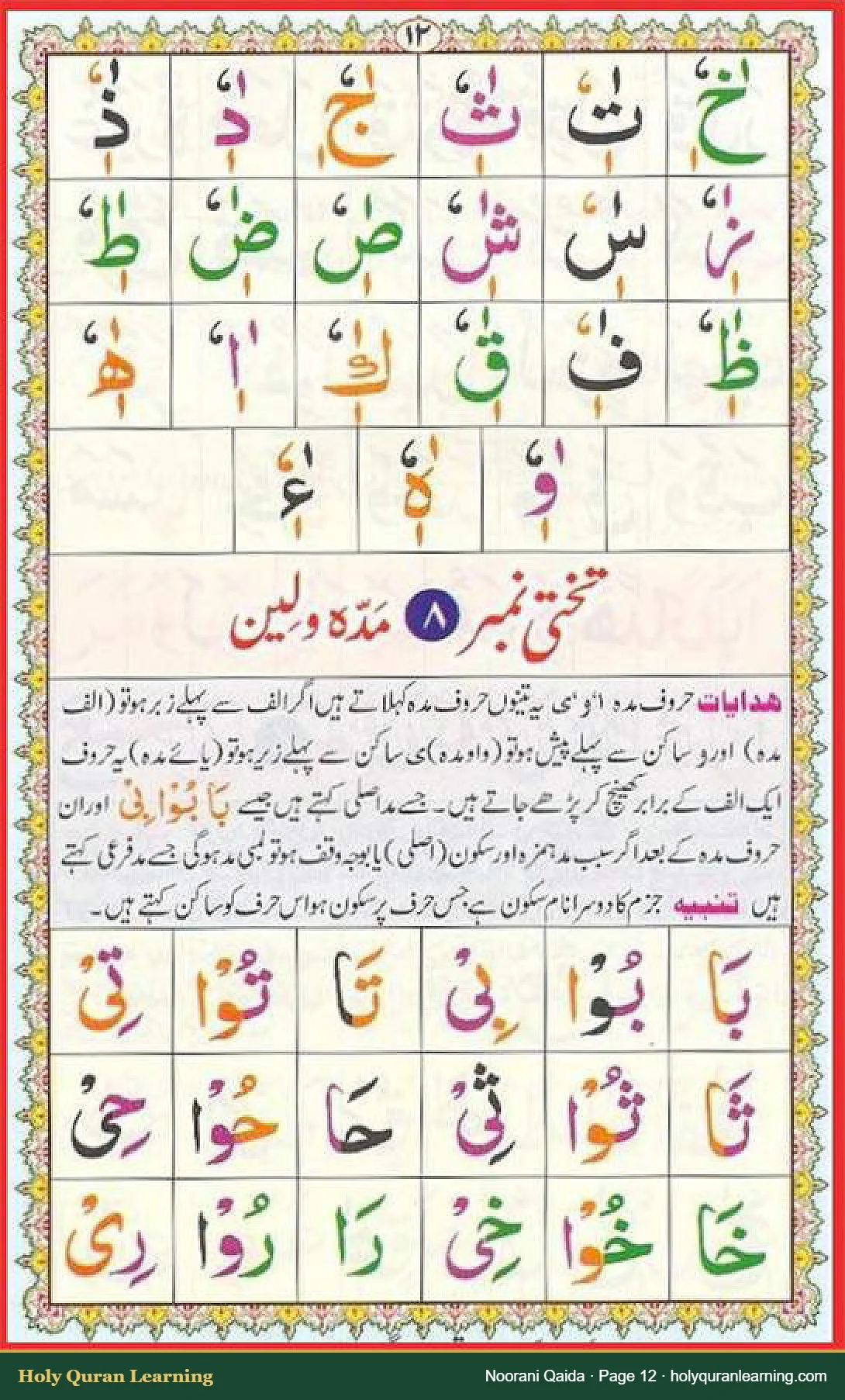
Noorani Qaida Page 12 Online: Khari Harakat (standing vowels) and Huroof Madda o Leen (long and soft vowels), Practice for Kids
Noorani Qaida page 12 covers standing vowel practice and the introduction of Madd and Leen (Takhti 7 and 8). It is page 12 of 32 in the colour-coded Urdu edition of the Qaida, shown in high resolution so every dot and vowel sign is clear for online practice with your child.
What is on Noorani Qaida page 12?
This page contains standing vowel practice and the introduction of Madd and Leen. Takhti 7 teaches the standing vowels: the standing Fatha (Khara Zabar), standing Kasra (Khari Zer) and inverted Damma (Ulta Pesh). Each one lengthens the vowel to two counts, the same length as a letter of Madd. Takhti 8 explains the letters of Madd and Leen. Alif after Fatha, Waw Saakin after Damma and Ya Saakin after Kasra stretch the sound to two counts. Waw or Ya Saakin after a Fatha make a soft (Leen) sound, read gently without extra stretching.
How to practise page 12
- Hold every standing vowel for two counts: baa, bee, boo.
- Compare a normal vowel and a standing vowel on the same letter.
- Stretch every Madd letter for exactly two counts.
- Read Leen words softly: "khauf", "bait", without a jerk.
Common mistakes on this page
- Reading the standing Fatha as a short vowel.
- Stretching some long vowels more than others.
- Adding a jerk to Leen letters.
Lesson at a glance
| Lesson | Takhti | Pages |
|---|---|---|
| Khari Harakat (standing vowels) کھڑی حرکات | Takhti 7 | 11, 12 |
| Huroof Madda o Leen (long and soft vowels) حروفِ مدہ و لین | Takhti 8 | 12, 13, 14 |
Questions about this page
What is on Noorani Qaida page 12?
Noorani Qaida page 12 covers standing vowel practice and the introduction of Madd and Leen (Takhti 7 and 8).
Which lesson is Noorani Qaida page 12?
Page 12 belongs to Khari Harakat (standing vowels) and Huroof Madda o Leen (long and soft vowels) (Takhti 7 and 8). The lesson runs across pages 11, 12.
How long does it take to learn page 12?
Most children need two to four short daily sessions of 15 to 20 minutes for one page, and adults often need one or two. Move on only when the whole page can be read without spelling.
Finding this page hard?
A patient teacher can correct your pronunciation live, one to one, in 20 minutes a day. Every course starts with 3 free trial classes.
Book a free 3-day trial Noorani Qaida online classes →Go to any page of the Noorani Qaida
Back to the full Noorani Qaida PDF, read the lesson by lesson guide to learning Noorani Qaida, or see our online Tajweed classes for the next step.