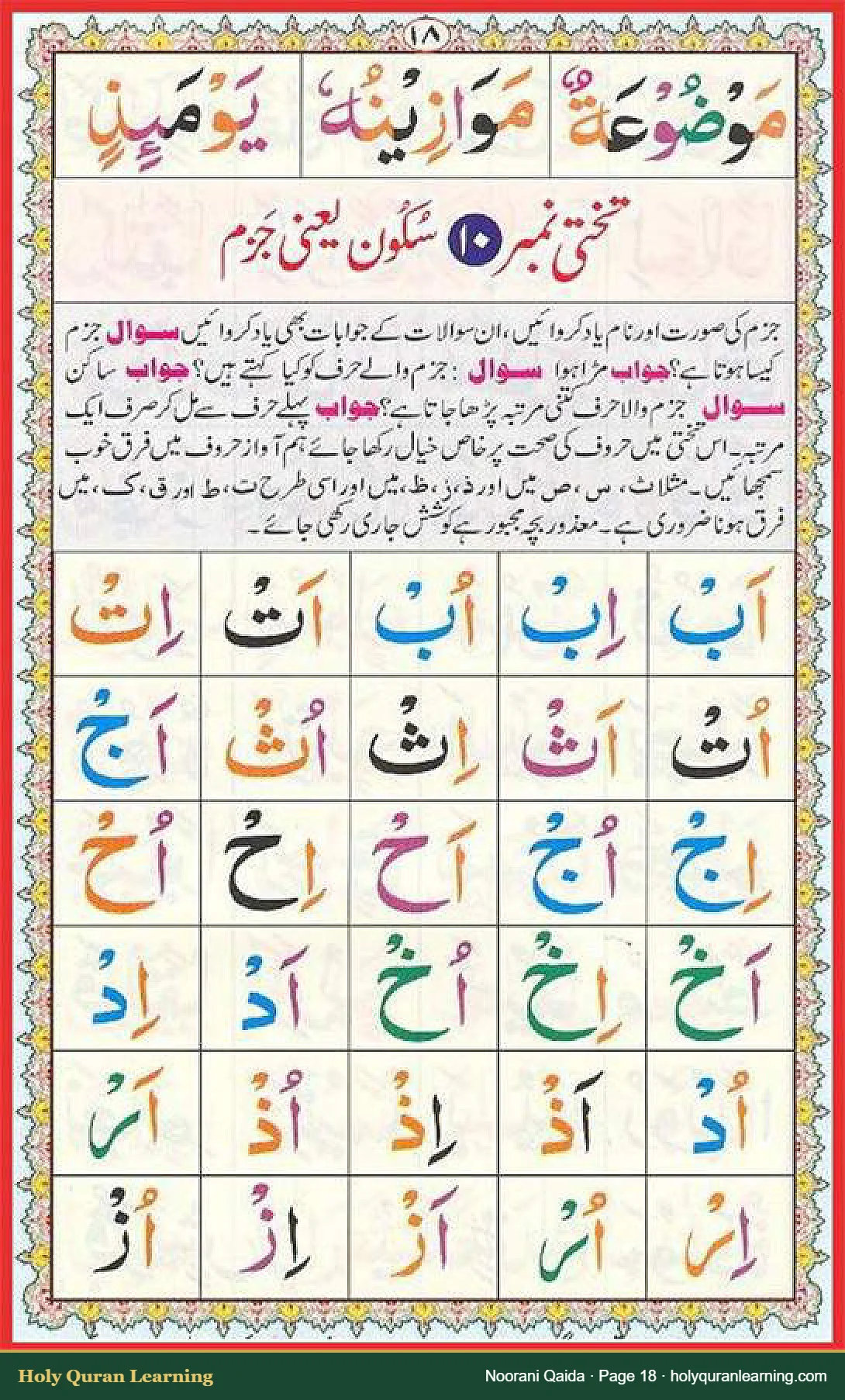
Noorani Qaida Page 18 Online: Mashq Harakat, Madd and Leen (practice) and Sukoon or Jazm, Practice for Kids
Noorani Qaida page 18 covers the end of mixed practice and the introduction of Sukoon (Jazm) (Takhti 9 and 10). It is page 18 of 32 in the colour-coded Urdu edition of the Qaida, shown in high resolution so every dot and vowel sign is clear for online practice with your child.
What is on Noorani Qaida page 18?
This page contains the end of mixed practice and the introduction of Sukoon (Jazm). Takhti 9 mixes everything learned so far, short vowels, Tanween, Madd and Leen, into real Quranic words. This is where reading starts to sound like recitation. Takhti 10 introduces Sukoon (Jazm), the sign that shows a letter has no vowel. A letter with Sukoon is joined to the letter before it and read in one sound, for example اَبْ is read "ab". The Qalqalah letters ق ط ب ج د bounce slightly when they carry a Sukoon.
How to practise page 18
- Read each word slowly, checking short and long vowels before speeding up.
- Mark the words you hesitate on and repeat them the next day.
- Join the Saakin letter to the letter before it in one sound.
- Practise the Qalqalah letters ق ط ب ج د with a light echo.
Common mistakes on this page
- Rushing and losing the difference between short and long vowels.
- Adding a small vowel after a Saakin letter.
- Forgetting the bounce on Qalqalah letters.
Lesson at a glance
| Lesson | Takhti | Pages |
|---|---|---|
| Mashq Harakat, Madd and Leen (practice) مشق | Takhti 9 | 15, 16, 17, 18 |
| Sukoon or Jazm سکون / جزم | Takhti 10 | 18, 19 |
Questions about this page
What is on Noorani Qaida page 18?
Noorani Qaida page 18 covers the end of mixed practice and the introduction of Sukoon (Jazm) (Takhti 9 and 10).
Which lesson is Noorani Qaida page 18?
Page 18 belongs to Mashq Harakat, Madd and Leen (practice) and Sukoon or Jazm (Takhti 9 and 10). The lesson runs across pages 15, 16, 17, 18.
How long does it take to learn page 18?
Most children need two to four short daily sessions of 15 to 20 minutes for one page, and adults often need one or two. Move on only when the whole page can be read without spelling.
Finding this page hard?
A patient teacher can correct your pronunciation live, one to one, in 20 minutes a day. Every course starts with 3 free trial classes.
Book a free 3-day trial Noorani Qaida online classes →Go to any page of the Noorani Qaida
Back to the full Noorani Qaida PDF, read the lesson by lesson guide to learning Noorani Qaida, or see our online Tajweed classes for the next step.