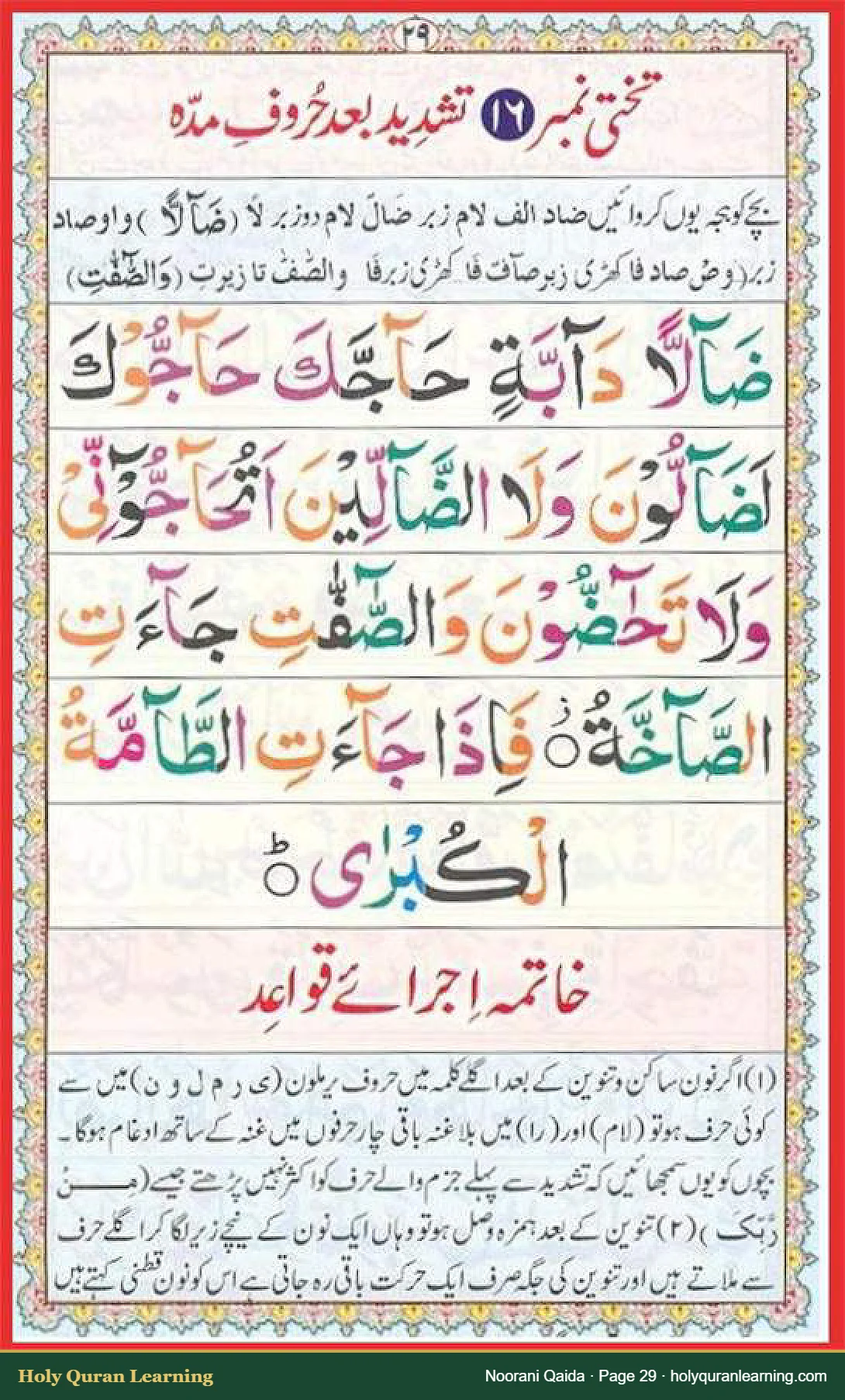
Noorani Qaida Page 29 Online: Tashdeed ma' Tashdeed (Shaddah after Shaddah) and Tashdeed after Huroof Madda (Madd before Shaddah), Practice for Kids
Noorani Qaida page 29 covers Tashdeed after Tashdeed, Tashdeed after a Madd letter and the end of the rules (Khatm) (Takhti 15 and 16). It is page 29 of 32 in the colour-coded Urdu edition of the Qaida, shown in high resolution so every dot and vowel sign is clear for online practice with your child.
What is on Noorani Qaida page 29?
This page contains Tashdeed after Tashdeed, Tashdeed after a Madd letter and the end of the rules (Khatm). Takhti 15 practises words where one Tashdeed comes straight after another, a pattern found often in the Quran. Each doubled letter must be pressed clearly. Takhti 16, the last lesson, teaches a Tashdeed that comes straight after a letter of Madd, as in وَلَا الضَّآلِّيْنَ and الطَّآمَّةُ. Here the Madd is stretched longer, usually six counts (Madd Lazim), before the doubled letter.
How to practise page 29
- Read the first doubled letter fully before moving to the next.
- Keep a steady rhythm so the two doublings do not merge.
- Stretch the Madd fully before pressing the doubled letter.
- Practise with الضَّآلِّيْنَ from Surah Al Fatiha.
Common mistakes on this page
- Merging two doubled letters into one sound.
- Shortening the long Madd before a Tashdeed.
Lesson at a glance
| Lesson | Takhti | Pages |
|---|---|---|
| Tashdeed ma' Tashdeed (Shaddah after Shaddah) تشدید مع تشدید | Takhti 15 | 28, 29 |
| Tashdeed after Huroof Madda (Madd before Shaddah) تشدید بعد حروفِ مدہ | Takhti 16 | 29 |
Questions about this page
What is on Noorani Qaida page 29?
Noorani Qaida page 29 covers Tashdeed after Tashdeed, Tashdeed after a Madd letter and the end of the rules (Khatm) (Takhti 15 and 16).
Which lesson is Noorani Qaida page 29?
Page 29 belongs to Tashdeed ma' Tashdeed (Shaddah after Shaddah) and Tashdeed after Huroof Madda (Madd before Shaddah) (Takhti 15 and 16). The lesson runs across pages 28, 29.
How long does it take to learn page 29?
Most children need two to four short daily sessions of 15 to 20 minutes for one page, and adults often need one or two. Move on only when the whole page can be read without spelling.
Finding this page hard?
A patient teacher can correct your pronunciation live, one to one, in 20 minutes a day. Every course starts with 3 free trial classes.
Book a free 3-day trial Noorani Qaida online classes →Go to any page of the Noorani Qaida
Back to the full Noorani Qaida PDF, read the lesson by lesson guide to learning Noorani Qaida, or see our online Tajweed classes for the next step.